living
Bedside Table Styling: How to Create a Calm, Beautiful Nightstand
Discover simple bedside table styling ideas to create a calm, functional and beautiful nightstand with the right balance of essentials, storage and empty space.

The bedside table is a small surface.
But because it sits right beside the bed, you notice it every day.
And because you use it at the beginning and end of your day, it needs to do more than look good.
It needs to work.
Your lamp needs to be easy to reach.
Your phone needs somewhere to go.
Your book shouldn't be buried underneath other things.
Your glasses shouldn't disappear.
And there should still be enough space for the occasional glass of water.
This is why good bedside table styling isn't about filling a nightstand with beautiful objects.
It's about creating a small arrangement where function and aesthetics work together.
The most successful bedside tables usually have something in common:
They feel calm without feeling empty.
They feel personal without feeling cluttered.
And every object seems to have a reason for being there.
Key Takeaways
- Start with your bedtime and morning routines before styling.
- Use the lamp as the primary visual anchor.
- Create three levels of height where possible.
- Keep the number of objects limited.
- Give your phone a defined position.
- An aesthetic phone stand can provide function while contributing to the composition.
- Use trays selectively to group small objects.
- Leave intentional empty space.
- Don't make every object match.
- The best bedside styling looks effortless because the arrangement has been carefully edited.
What Is Good Bedside Table Styling?
Good styling isn't about following a fixed formula.
It's about creating a relationship between the objects on the table.
Think about:
- height
- scale
- colour
- material
- spacing
- function
For example, a tall lamp beside a low book creates contrast.
A phone stand introduces a smaller vertical element.
A tray groups several small objects.
The empty space prevents everything from competing.
That's styling.
You're not simply placing objects on a surface.
You're creating visual hierarchy.
Start With Function
Before adding anything decorative, ask:
What do I actually use beside the bed?
Perhaps:
- lamp
- phone
- book
- glasses
- water
Those are your starting points.
Only after those are placed should you consider decoration.
This prevents a common mistake:
creating a beautiful bedside table that isn't actually practical.
Your nightstand should support your routine first.
Step 1: Choose Your Visual Anchor
For most bedside tables, the lamp is the natural anchor.
It's usually the tallest object.
Position it first.
Then look at the remaining space.
Is the table balanced?
Does the lamp overwhelm it?
Does the table feel empty?
Don't immediately add something.
Give yourself a moment to see what the existing arrangement needs.
Sometimes it needs nothing.
Step 2: Give Your Phone a Defined Position
The phone is one of the most frequently used objects on a bedside table.
It's also one of the easiest to let become visually messy.
It lies flat.
The cable trails across the surface.
It moves around.
It ends up underneath a book.
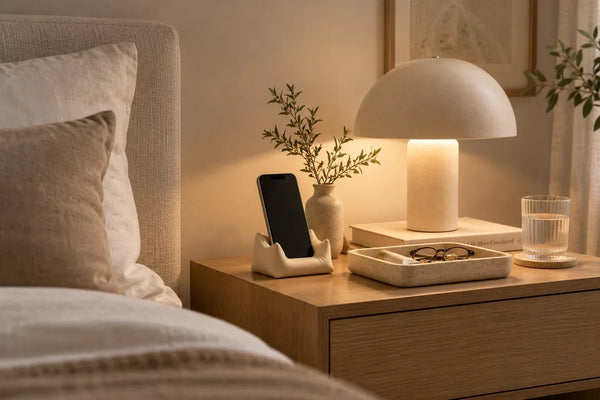
An aesthetic phone stand gives it a defined location.
This can be especially useful on a small nightstand because the phone can sit upright rather than taking up valuable horizontal space.
It also creates another visual level between the lamp and the lower objects.
Step 3: Create Three Levels
A simple styling principle is:
Tall
Lamp.
Medium
Phone stand.
Low
Book, tray or glasses.
This creates visual rhythm.
You don't need ten objects.
You simply need enough variation in height to prevent everything from sitting on one visual plane.
Step 4: Add One Functional Object
Choose something you actually use.
A book is a natural choice.
So are glasses.
Or a small tray.
The key is to avoid adding several objects just because the table still has room.
A bedside table is not a shelf.
It is a working surface.
Step 5: Add One Personal Detail
Now you can introduce personality.
Perhaps:
- a small ceramic piece
- a photograph
- a tiny vase
- a meaningful object
- a small piece of art
One can be enough.
The purpose isn't to create a display.
It's to make the space feel like yours.
How Many Objects Should Be on a Bedside Table?
There is no fixed number.
But if you're unsure, start with three to five visible objects.
For example:
lamp + phone stand + book + water
or:
lamp + phone stand + tray + glasses
Then look at the table.
Does it feel finished?
If yes, stop.
The biggest styling mistake is continuing after the arrangement already works.
How Do You Style a Small Bedside Table?
Small surfaces need more restraint.
Try:
compact lamp
phone stand
one book
That's already enough for many tables.
If you need more objects, use a small tray to group them.
And don't forget the wall.
If the surface is limited, visual interest can move upward through:
- artwork
- a wall light
- a mirror
- shelving
You don't have to solve every design problem on the tabletop.
How Does an Aesthetic Phone Stand Fit Into Bedside Styling?
This is where function and design meet.
Your phone already needs to be there.
The stand simply changes how it occupies the space.
Instead of:
phone lying flat + cable crossing table
you have:
phone upright + defined position + controlled cable
That can make the entire surface feel more intentional.
An aesthetic phone stand is therefore not decorative for decoration's sake.
Its aesthetic value comes from making a necessary everyday object fit more naturally into the room.
What Makes a Phone Stand Look Good on a Nightstand?
Look for:
Proportion
The stand shouldn't overwhelm the table.
Visual weight
It should feel stable without looking bulky.
Simplicity
A clean form is easier to integrate.
Material
Consider how it relates to the lamp and furniture.
Position
Even a beautiful stand can look awkward if it's placed randomly.
The product is only part of the composition.
Placement matters just as much.
How Do You Style a Bedside Table With a Lamp?
The lamp usually creates the strongest vertical line.
You can balance it with a smaller vertical element such as a phone stand.
Then keep the lower objects simple.
For example:
lamp
↕️
phone stand
↕️
book / tray
This creates a gentle visual hierarchy.
The result can feel balanced without being perfectly symmetrical.
Should Bedside Tables Be Symmetrical?
Not necessarily.
Symmetry can work beautifully when you have matching bedside tables and lamps.
But you don't need identical objects on both sides of the bed.
One side might have:
lamp + phone stand + book
while the other has:
lamp + phone stand + water
The overall composition can still feel balanced.
Think about visual weight, not exact duplication.
Bedside Table Styling for a Minimalist Bedroom
A minimalist bedside table might contain only:
lamp + phone stand + book
The simplicity comes from the editing.
Use:
- fewer objects
- restrained colours
- clear spacing
- simple shapes
- useful accessories
A minimalist bedside table doesn't have to be cold.
Warm wood, soft lighting and natural textures can keep it inviting.
Bedside Table Styling for a Warm Bedroom
If your bedroom has warmer materials, repeat those cues.
Think:
- wood
- cream
- beige
- warm lighting
- natural textures
- muted colours
Your accessories don't have to match the furniture exactly.
They simply need to feel related.
An aesthetic phone stand can act as a small modern element within an otherwise warm arrangement.
That contrast can actually make the styling more interesting.
Bedside Table Styling for a Modern Bedroom
A contemporary bedroom may suit:
- cleaner silhouettes
- stronger contrast
- fewer decorative objects
- simple materials
- controlled spacing
In this setting, avoid over-accessorising.
Let the architecture and furniture provide the visual interest.
The bedside table can remain relatively quiet.
What Colours Work Best for a Bedside Table?
There is no universal answer.
The right colours depend on the bedroom.
But a useful approach is to select:
one dominant neutral + one material + one accent
For example:
cream + wood + dark accent
or:
white + warm wood + muted colour
The exact palette matters less than consistency.
What Materials Work Well Together?
Try repeating one or two materials.
For example:
wood bedside table
wood or ceramic object
metal lamp detail
You don't need everything to be made from the same material.
A little contrast gives the arrangement character.
The goal is to avoid a random collection of unrelated finishes.
What Is Bedside Table Decor Worth Keeping?
Ask whether it contributes something.
A decorative object can be worth keeping if:
- you genuinely like it
- it has personal meaning
- it balances the composition
- it adds texture
- it relates to the room
It isn't worth keeping simply because the table looked empty without it.
Empty space is not a problem.
Don't Forget the Charging Cable
The cable is part of your styling.
You can create a beautiful nightstand and then undermine it with a cable running diagonally across the surface.
Try to:
- position the stand close to the charging point
- route the cable toward the back
- minimise excess length
- keep the cable away from the front edge
The goal is not necessarily to hide technology.
It's to make it visually manageable.
How Do You Style a Bedside Table Without Making It Look Staged?
This is important.
A bedside table should look lived in, not like a showroom.
Keep a few objects you actually use.
A book you're currently reading.
Your glasses.
Your phone.
Your lamp.
A small personal object.
The authenticity comes from function.
The styling comes from editing.
Common Bedside Styling Mistakes
Too many objects
The table becomes visually noisy.
Everything is the same height
The arrangement feels flat.
No empty space
The surface becomes difficult to use.
Too much decoration
Function gets sacrificed.
Poor cable placement
Technology becomes visually dominant.
Oversized lamp
The table feels unbalanced.
Too many matching objects
The room starts to feel overly staged.
No defined place for the phone
The most frequently used object becomes the least organised.
A Simple Bedside Styling Formula
If you're starting from scratch, try this:
1. Lamp
Your visual anchor.
2. Phone stand
Your everyday technology zone.
3. Book
Your lower horizontal element.
4. One small personal object
Your personality.
5. Empty space
Your breathing room.
That's it.
You can add more only if your routine genuinely requires it.
Bedside Table Styling for Small Apartments
When space is limited, the styling should become more intentional.
A compact table might need to hold everything you use at night.
That's why small bedside table ideas often rely on:
- vertical storage
- compact lamps
- small trays
- defined phone positions
- fewer decorative objects
In a smaller UAE apartment, for example, the bedroom may need to balance storage, furniture and circulation carefully.
The bedside table should support that rather than compete with it.
Your Nightstand Doesn't Need to Be Perfect
The bedside table is one of the most personal surfaces in your home.
It will get used.
Things will move.
Books will be opened.
Water glasses will appear.
The phone will need charging.
That's normal.
Good styling doesn't prevent life from happening.
It simply makes the space easier to return to.
The Most Beautiful Bedside Tables Are Usually the Most Intentional
You don't need a huge nightstand.
You don't need expensive decor.
You don't need a perfect matching set.
You need:
good proportions
useful objects
clear spacing
a little personality
a defined place for the things you use
That's what makes bedside table styling feel effortless.
And when a necessary modern object such as your phone is incorporated thoughtfully, it can become part of the room rather than an interruption to it.
Key Takeaways
For a calm bedside table:
- start with the lamp
- define your phone's position
- create different heights
- keep objects limited
- add one personal detail
- control the charging cable
- leave visible empty space
- choose complementary materials
- prioritise function over decoration
An aesthetic phone stand can be particularly useful because it gives the phone a deliberate place within the composition.
The result isn't just a prettier nightstand.
It's a more functional one.
Frequently Asked Questions
How do I style a bedside table?
Start with the lamp, then add the objects you actually use, such as a phone, book or glasses. Create different heights and leave some empty space.
What should go on a bedside table?
Common essentials include a lamp, phone, book, glasses and water. Choose only the objects that support your personal routine.
How do I style a small bedside table?
Use fewer objects, choose compact accessories and make use of vertical space. A phone stand can keep your phone upright while using less horizontal space.
Is a phone stand useful on a bedside table?
Yes. It gives your phone a defined position, keeps it accessible and can make charging easier to manage.
What is an aesthetic phone stand?
It is a phone stand designed to combine everyday function with thoughtful proportions, materials and visual simplicity.
How many things should be on a bedside table?
There is no fixed number. Start with the essentials and stop when the surface feels functional and balanced.
Should bedside tables match?
They can, but they don't have to. Similar visual weight, materials or lamps can create cohesion without identical styling.
How do I hide the phone charging cable?
Position the phone stand close to the charging point and route the cable toward the back of the table, keeping excess cable controlled.
How do I make my bedside table look expensive?
Focus on proportion, spacing, fewer objects, complementary materials and good-quality-looking finishes rather than simply adding expensive decor.