living
What a Work-From-Home Setup Should Feel Like
A work-from-home setup should feel like part of your home, not a separate office. Discover simple ways to organise your desk, position everyday devices and create a workspace that feels calm, comfortable and considered.

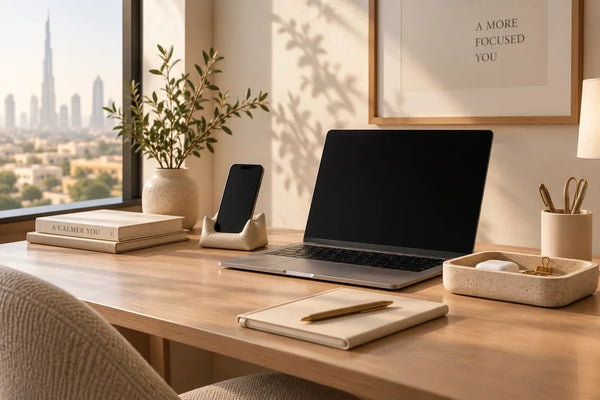
A good work-from-home setup shouldn't feel like an office you built. It should feel like a corner of your home that happens to hold work.
The objects on it should have a fixed place. Your screen should sit at a comfortable height. Your phone should be easy to see without constantly picking it up. And when the workday ends, the same desk should feel just as at home holding a coffee as it did holding a laptop.
This isn't about productivity hacks or building the perfect home office. It's about creating a workspace that feels considered, comfortable and easy to live with — and the handful of small decisions that get you there.
What Makes a Good Work-From-Home Setup?
A good work-from-home setup is one that makes your everyday routine easier without making your home feel like an office.
Start with the way you actually work. Consider where you sit, how much space you have, which devices you use most and what tends to create clutter.
For some people, that means a dedicated home office. For others, it's a desk in a bedroom, a corner of the living room or a small surface that has to serve several purposes throughout the day.
The size of the space matters less than how well it works.
A good setup usually has three things in common:
- Frequently used objects are easy to reach.
- Devices are positioned comfortably rather than left flat on the desk.
- Everything has a place, so the workspace can be reset at the end of the day.
The result should feel functional without feeling clinical.
What's the Difference Between a Desk and a Work-From-Home Setup?
Almost anyone working from home has a desk. Far fewer have a setup that actually feels like theirs.
A desk is furniture. A setup is a small, considered system.
It might include a phone stand for your phone, a tablet stand within reach, somewhere to keep your earbuds and enough clear space for your laptop or notebook. None of these things are essential individually. Together, they can remove the small moments of friction that make a desk feel disorganised.
Without a defined place, a phone gets left face-down beside the laptop. Earbuds disappear into a drawer or bag. A tablet ends up propped against a stack of books.
The difference isn't really about square footage.
It's about whether the objects around you have somewhere to belong.
How Do You Organise a Work-From-Home Desk?
The easiest way to organise a home workspace is to start with the objects you use most often rather than buying more storage.
Give Everyday Objects a Fixed Place
Your phone, earbuds, notebook and charging cable are likely to move around the desk throughout the day.
Giving each one a defined position makes the workspace easier to reset and means you don't have to search for things when you need them.
Keep the Most-Used Objects Within Reach
Things you use repeatedly should be accessible without interrupting your work.
A phone stand can keep your phone upright and visible. An earbud stand can keep your earbuds in one place between calls. A tablet stand can give a second screen a more useful viewing position.
The objective isn't to fill the desk with accessories. It's to make the things already on the desk easier to use.
Protect Your Clear Working Area
Organisation should never take over the workspace.
Leave enough room for your laptop, keyboard, notebook or whatever you use most. Clear surface area is part of a good organisation system — it isn't space that needs to be filled.
Deal With Cables Before They Become Clutter
Charging cables are often one of the quickest ways for a home desk to start looking messy.
Keep charging points close to where your devices normally sit and avoid allowing unused cables to spread across the working surface.
Small changes like this make the desk easier to maintain throughout the day.
Why Do Phone Stands and Earbud Stands Matter?
The big pieces of a home office rarely cause the most daily frustration. It's usually the small objects that don't have a proper place.
A phone might be needed during a video call, kept nearby for messages or used as a second screen. Leaving it flat on the desk makes it harder to see and can mean repeatedly picking it up and putting it down.
A phone stand keeps the device upright, visible and ready to use.
Earbuds have the same problem. Without a fixed place, they tend to end up in a bag, drawer or somewhere beneath the papers on the desk.
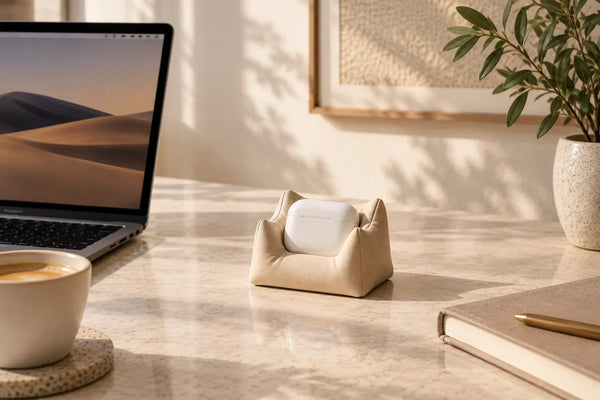
An earbud stand gives them a simple home between calls.
The Pod is designed as a compact earbud and AirPods stand that keeps earbuds upright and visible without taking over the desk.
These are small decisions, but they're exactly the kind that make a work-from-home setup feel easier to live with.
How Should You Position Your Phone and Tablet?
Your devices should be positioned according to how you use them rather than simply where there happens to be space.
If you regularly check your phone during work, keeping it upright and within your natural eyeline is more useful than leaving it flat beside your keyboard.
A tablet used for documents, video calls or reading benefits from the same approach. Raising the screen can make it easier to view without constantly leaning forward or propping it against whatever happens to be nearby.
For Video Calls
Try to keep your phone or tablet high enough that you're not looking sharply downward into the screen.
The aim is a more natural viewing position while keeping the device stable.
For Reading and Documents
If you're using a tablet as a second screen, a stand can keep it at a consistent angle rather than leaving it flat on the desk.
For Occasional Use
Not every device needs to remain permanently positioned.
If you only use your tablet occasionally, choose a compact stand that can stay neatly to one side until you need it.
The right setup depends on your routine. The important thing is that your devices are positioned intentionally rather than improvised around the desk.
How Do You Make a Home Office Feel Less Like an Office?
A work-from-home space works best when it still feels connected to the rest of your home.
You don't necessarily need matching furniture or a dedicated office room. In fact, a smaller and more restrained setup can often feel more natural.
Choose Fewer, Better-Considered Objects
A desk doesn't need to be filled with accessories to look finished.
Start with what you genuinely use and remove things that don't serve a clear purpose.
Keep the Visual Language Simple
Neutral colours, matte finishes and simple forms can help functional objects sit more naturally within a home.
The aim isn't to make everything identical. It's to avoid the visual noise that can make a workspace feel temporary or overly commercial.
Leave Some Space Around Each Object
Objects feel more considered when they aren't crowded together.
Leaving some clear surface around your phone stand, tablet or notebook can make even a compact desk feel more spacious.
Let the Setup Work Beyond Work
A home workspace doesn't disappear when the laptop closes.
The same desk might hold your morning coffee, a recipe on your tablet or a phone while you're listening to something in the evening.
Designing the setup around real life makes it feel like part of your home rather than a separate office zone.
How Do You Create a Work-From-Home Setup for a Small Space?
You don't need a large room to create a comfortable work-from-home setup.
The key is to make every object justify the space it occupies.
Use vertical space where possible. Keep frequently used devices upright rather than flat. Avoid large organisers that take up valuable surface area when a smaller stand can do the job.
If your desk doubles as another surface, choose pieces that are easy to move or that don't visually dominate the room.
A compact workspace can actually feel more considered because it forces you to be selective.
The goal isn't to fit everything onto the desk.
It's to make room for the things that genuinely belong there.
How Can You Make Working From Home Feel More Relaxed?
There is a particular kind of relief in starting a workday without unnecessary friction.
Your phone is where you expect it to be. Your earbuds are ready for a call. Your tablet is already at a comfortable angle. There is enough clear space to open your laptop without first moving five other things.
That sense of order doesn't have to mean an aggressively minimalist desk.
A few small decisions can change the tone of the space.
The Lounge, for example, is designed to hold a tablet or phone at a taller, more upright angle. It can be useful for a video call, reading a document or following a recipe without needing to prop the device against another object.
The point isn't the accessory itself.
It's what the accessory removes from the routine: the balancing, searching, moving and rearranging that happens when everyday objects don't have a proper place.
Should a Work-From-Home Setup Extend Beyond the Desk?
Yes — especially if your workday doesn't end neatly when you close your laptop.
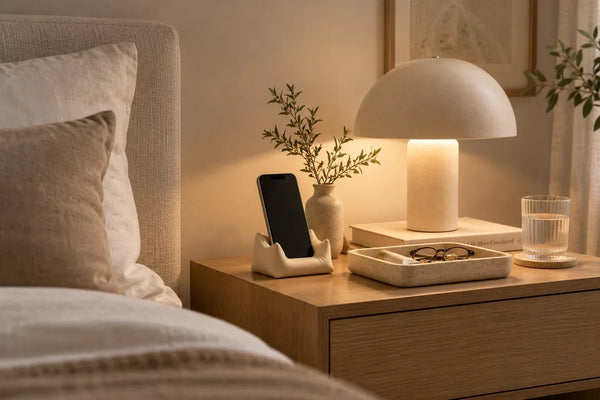
Many people move between spaces throughout the day. A final message might be answered from the sofa. A call might be taken from another room. A phone might follow you to the bedside table at the end of the evening.
That means the principles of a good desk setup can extend beyond the desk.
The Pillow is a bedside phone stand designed for that transition. It gives your phone a defined place on the nightstand rather than leaving it loose beside the bed.
The same idea applies throughout the home: useful objects work better when they have somewhere considered to live.
For more inspiration, our bedside table ideas article explores how to create a calmer, more intentional nightstand.
The Quiet Version of Productive
Most advice about home offices focuses on output — more focus, fewer distractions, better systems.
Less is said about how a workspace should simply feel to sit down at.
It should feel considered without feeling precious. Functional without feeling clinical. Personal without becoming cluttered.
Maybe it's the coffee cup you like, the lamp that's the right warmth, or a phone stand and earbud stand that hold the things you use every day without asking you to think about them.
That feeling is quieter than productivity.
But it may be what makes working from home feel sustainable rather than simply something you have to get through.
Frequently Asked Questions
What Makes a Work-From-Home Setup Feel Good?
A good setup makes everyday work easier without making your home feel like an office. Frequently used objects should have a fixed place, devices should be positioned comfortably, and enough clear surface should remain for you to work.
Do I Need a Full Home Office to Work Comfortably From Home?
No. A dedicated room can be useful, but a well-organised desk corner can work just as effectively for many routines. Focus on the space you have, the devices you use and the objects that need to stay within reach.
How Should I Organise a Small Work-From-Home Desk?
Keep frequently used objects close, use vertical space where possible, control charging cables and protect a clear area for your laptop or notebook. Avoid filling the desk with storage and accessories that you rarely use.
Is a Phone Stand Useful for Working From Home?
Yes. A phone stand can keep your phone upright and visible, making it easier to check notifications, join calls or use your phone as a second screen without repeatedly picking it up.
Where Should I Keep My Earbuds While Working?
Keep them in a fixed, visible location close to your desk. An earbud or AirPods stand can make them easier to find before calls while keeping the desk more organised.
Can a Work-From-Home Setup Look Good Without Being Minimalist?
Yes. A good setup doesn't need to be completely empty. The goal is to choose useful objects, give them defined places and avoid unnecessary visual clutter.
Should My Work-From-Home Setup Extend Beyond My Desk?
If your routine moves into other parts of the home, it can help. A bedside phone stand, for example, can give your phone a defined place after the workday ends and create a smoother transition between work and evening.
A Setup Worth Sitting Down To
A work-from-home setup doesn't need to be elaborate to feel right.
It needs a handful of decisions made well — where your phone sits, where your tablet sits, where your earbuds live, how much clear space remains, and how the evening winds down.
Over time, those decisions stop feeling like decisions at all.
That's the setup worth having.
Not the one that looks finished in a photograph, but the one that quietly works every day — from the moment you sit down to work to the moment you finally stand up.
Explore The Lounge, The Pod and The Pillow to see how a few small additions can bring more order and intention to different parts of the day.