living
How to Style a Bedside Table Without Making It Feel Cluttered
Create a calmer bedside table without redecorating. Simple ideas for bedside organisation, styling, visual calm and everyday routines.

A bedside table can be one of the smallest surfaces in a bedroom, yet it often ends up carrying everything: your phone, a book, a glass of water, a lamp, chargers, skincare, glasses and all the little things you reach for before bed.
The result is familiar: a surface that feels busy even when the rest of the bedroom is calm.
Good bedside table styling isn't about adding more decoration. It's about deciding what deserves to stay, giving everyday objects a place, and leaving enough breathing room for the space to feel restful.
Whether you have a generous bedside table or a small surface in a compact bedroom, a few thoughtful choices can make a noticeable difference.
What Makes a Bedside Table Feel Cluttered?
A bedside table usually feels cluttered when too many objects compete for attention without having a clear purpose or place.
The problem isn't necessarily the number of things. A bedside table with five carefully arranged objects can feel calmer than one with three things scattered across the surface.
Common sources of visual clutter include:
-
charging cables left loose across the surface
-
several small objects without a defined place
-
too many decorative pieces
-
items that belong somewhere else
-
different colours and materials competing with each other
-
objects stacked without intention
-
using every available centimetre of the surface
The simplest solution is to think about your bedside table as a small, functional composition rather than a storage area.
Start With What You Actually Use
Before styling your bedside table, clear everything from the surface.
Then ask yourself:
What do I actually use here every evening or morning?
Your essentials might include:
-
a lamp
-
your phone
-
a book
-
glasses
-
a water glass or bottle
-
a small personal object
-
something you use as part of your evening routine
Everything else can probably live somewhere else.
This is particularly useful in smaller bedrooms, where every surface has to work harder.
A bedside table doesn't need to display your entire routine. It only needs to support the parts of your routine that happen there.
Choose One Visual Anchor
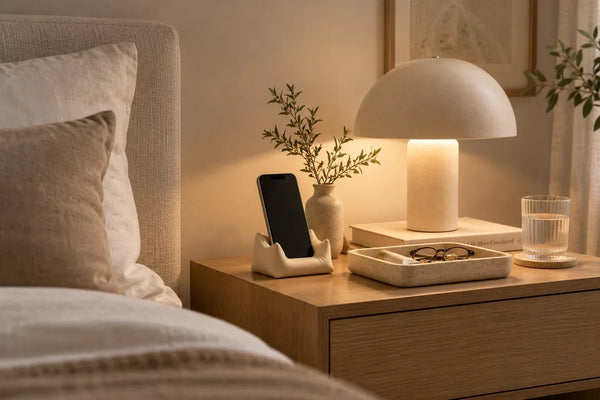
One of the easiest ways to make bedside table styling feel intentional is to choose one dominant object.
This might be:
-
a table lamp
-
a vase
-
a sculptural object
-
a stack of books
-
another object with visual weight
Once you have your anchor, arrange the smaller objects around it.
This creates hierarchy.
Instead of every item demanding attention, one element becomes the visual starting point and everything else supports it.
Create Different Heights
If everything on your bedside table sits at exactly the same height, the arrangement can look flat.
Try combining different levels instead.
For example:
Tall: lamp
Medium: vase, phone stand or decorative object
Low: book, tray or small personal item
Different heights create visual rhythm without requiring more objects.
This is particularly useful when styling a minimalist bedside table because the arrangement can remain simple while still feeling considered.
Keep Your Colour Palette Restrained
You don't need every object on your bedside table to match.
But when colours, finishes and materials are highly varied, even a small number of objects can create visual noise.
A simple approach is to work within two or three complementary tones.
For example:
-
warm neutrals + natural materials
-
cream + wood + muted colour
-
black + white + one accent
-
soft tones + one darker element
The goal isn't perfection.
It's coherence.
When the objects relate to one another visually, the surface tends to feel calmer.
Give Small Objects a Home
Small objects are often what make a bedside table feel messy.
Think:
-
jewellery
-
hair ties
-
earbuds
-
keys
-
lip balm
-
charging accessories
-
glasses
A small tray or defined container can immediately make these items feel more intentional.
Instead of several little objects spreading across the surface, they occupy one visual zone.
This is especially helpful if you have a small bedside table where there isn't much room to begin with.
Leave Some Empty Space
One of the most overlooked parts of good bedside table styling is the space where nothing is placed.
You don't need to fill every corner.
In fact, leaving part of the surface empty can make everything else feel more deliberate.
Think of negative space as part of the design.
A lamp, book and phone stand with space between them can look considerably calmer than the same three objects pushed together.
The empty space gives your eye somewhere to rest.
Where Should Your Phone Go?
For many people, the phone is the most visually disruptive object on the bedside table.
It is also one of the things you genuinely need there.
Rather than pretending it doesn't belong, give it a proper place.
An aesthetic phone stand can be useful here because it gives your phone a defined position while keeping it accessible.
Instead of lying flat beside your bed or resting against another object, the phone becomes part of the arrangement.
This is a small change, but it can make the whole surface feel more intentional.
The best phone stand for a bedside table doesn't need to look like a piece of technology sitting in your bedroom. A well-designed aesthetic phone stand can function as an everyday object while still fitting naturally into the space around it.
How to Style a Small Bedside Table
If your bedside table is small, resist the temptation to compensate by adding more vertical or decorative elements.
Start with the essentials.
A simple combination might be:
one lamp + one book + your phone + one small personal object
That's enough.
If you need your phone nearby, consider giving it a dedicated vertical position rather than allowing it to occupy additional horizontal space.
You can also move less frequently used items away from the bedside table entirely.
Small spaces benefit from stronger editing.
The less your bedside table has to hold, the easier it becomes to make it feel calm.
Should Your Bedside Tables Match?
Not necessarily.
Matching bedside tables can create symmetry, which works beautifully in some bedrooms.
But identical styling isn't essential.
Two bedside tables can feel connected through:
-
similar colours
-
similar visual weight
-
a shared material
-
matching lamps
-
complementary accessories
You can also allow each side of the bed to reflect the person using it.
One person might keep a book and glasses nearby, while the other prefers a phone stand and a small object.
A bedroom can feel cohesive without becoming overly coordinated.
What Should You Remove From Your Bedside Table?
If your bedside table feels cluttered, start by removing anything you don't use there.
Look for:
-
old receipts
-
empty cups
-
packaging
-
unused skincare
-
tangled cables
-
random objects from other rooms
-
decorative items that no longer feel relevant
-
things you keep there simply because there is nowhere else to put them
Then look at what's left.
Ask:
Does this object support my routine, or is it simply occupying space?
That question can make decluttering much easier.
A Simple Five-Minute Bedside Table Reset
You don't need to completely redecorate your bedroom to make your bedside table feel better.
Try this five-minute reset:
1. Clear the entire surface
Start with a completely empty table.
2. Remove anything that doesn't belong
Return objects to their proper places.
3. Choose your essentials
Keep only the things you regularly use beside the bed.
4. Create one visual anchor
Let the lamp, books or another meaningful object establish the composition.
5. Give your phone a defined place
Instead of letting it lie wherever there is room, give it a dedicated position.
6. Leave some space
Don't fill the surface simply because you can.
The final step is often the one that makes the biggest difference.
A Calmer Bedside Table Doesn't Need More Things
The most successful bedside table styling isn't necessarily the most decorated.
It is the one that feels useful, balanced and easy to live with.
Choose objects that support your routine.
Give everyday things a defined place.
Use height and negative space to create visual balance.
And don't be afraid to leave part of the surface empty.
A bedside table should work for you first. When its objects are useful, beautiful and intentional, the styling tends to follow naturally.
Key Takeaways
-
Start with what you actually use. Your bedside table doesn't need to hold your entire routine.
-
Choose one visual anchor. A lamp or larger object can establish the arrangement.
-
Create different heights. This adds visual rhythm without adding clutter.
-
Group small objects together. Trays and defined zones prevent little items from spreading.
-
Keep the colour palette cohesive. Related tones make a small surface feel calmer.
-
Leave empty space. Negative space is part of good bedside table styling.
-
Give your phone a defined place. An aesthetic phone stand can keep it accessible without making it feel visually disruptive.
-
Edit regularly. A five-minute reset can keep the surface from gradually becoming cluttered again.
Frequently Asked Questions
How do I style a bedside table without clutter?
Keep only the objects you regularly use, choose one visual anchor, group smaller items together and leave some empty surface visible. The goal is to create function and visual hierarchy rather than fill the table.
How many items should be on a bedside table?
There is no fixed number. A useful starting point is three to five meaningful or functional objects, depending on the size of the table and your routine. What matters more than the number is whether each object has a purpose.
What should I keep on my bedside table?
Common essentials include a lamp, phone, book, glasses, water and one or two personal items. Choose according to your own routine rather than following a fixed checklist.
How do I make my bedside table look minimalist?
Remove anything you don't regularly use, keep the colour palette restrained, group small objects together and leave some negative space. Minimalist bedside table styling is more about editing than having fewer possessions overall.
How do you decorate a small bedside table?
Prioritise essentials and choose objects that serve a purpose. Use vertical space where appropriate and avoid filling the entire surface. A dedicated phone stand can also help keep your phone in one defined position.
What makes a bedside table look cluttered?
Loose cables, too many small objects, unrelated colours, unnecessary decoration and items that belong elsewhere are common causes of visual clutter.
Should a phone sit on a bedside table?
If you use your phone as part of your evening or morning routine, keeping it nearby can be practical. Giving it a defined position, such as an aesthetic phone stand, can make the arrangement feel more intentional.
Do bedside tables have to match?
No. Matching tables create symmetry, but different bedside tables can work beautifully when their colours, proportions or visual weight relate to each other.