living
How to Make Your Everyday Spaces Feel More Considered
Simple ways to make everyday spaces feel more considered, from thoughtful home decor and organisation to the small objects you use every day.

A home does not need a complete makeover to feel more thoughtful.
Sometimes, it simply needs a little more intention.
A bedside table crowded with chargers and books. A console collecting things that were never meant to live there. A desk that makes it harder to concentrate. A living room that looks finished but somehow does not feel like yours.
These small details shape how a home feels every day.
Creating thoughtful home spaces is rarely about buying more. It is about noticing how you live, deciding what deserves to stay, and giving everyday objects a natural place.
Whether you live in a Dubai apartment, a UAE villa, or a smaller urban home, the principle is much the same:
A considered home is one that works beautifully with the way you actually live.
Key Takeaways
-
A considered home is about intention, not perfection.
-
Start by observing how you actually use your space.
-
Edit clutter before buying new home décor.
-
Give frequently used objects a clear, convenient place.
-
Combine beauty with function wherever possible.
-
Leave negative space so rooms feel calmer and less crowded.
-
Keep personal objects that make your home feel like yours.
-
Choose accessories because they solve a real problem, not simply because a surface looks empty.
-
Thoughtful design can help Dubai and UAE homes, from compact apartments to larger villas, work more effectively.
In This Article
-
What Makes a Home Feel More Considered?
-
Start With How You Actually Live
-
Edit Before You Add
-
Give Everyday Objects a Proper Place
-
Let Useful Objects Become Part of the Décor
-
Create Visual Calm Without Making Everything Match
-
Design Around Everyday Moments
-
Make Smaller Spaces Work Harder
-
Make Your Home Feel Personal
-
Choose Fewer, Better Things
-
How to Choose Thoughtful Home Accessories
-
A Five-Minute Reset for a More Thoughtful Home
-
Thoughtful Living Starts With Small Decisions
-
Frequently Asked Questions
What Makes a Home Feel More Considered?
A considered home is not necessarily minimalist, expensive, or perfectly styled.
It simply feels intentional.
The objects around you have a purpose. Frequently used things are easy to reach. Surfaces have room to breathe. Personal belongings feel like part of the home rather than things waiting to be put away.
Most importantly, the space supports your routines.
A considered living room makes relaxing easier.
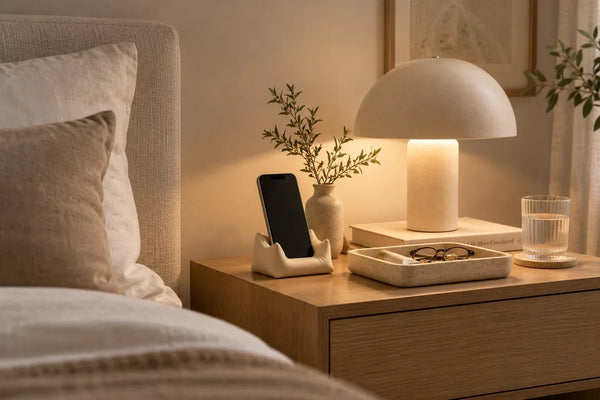
A considered bedroom helps the day wind down. If your bedside table tends to become a collection point for phones, books and chargers, our guide to bedside table ideas explores simple ways to make this small area feel calmer and more functional.
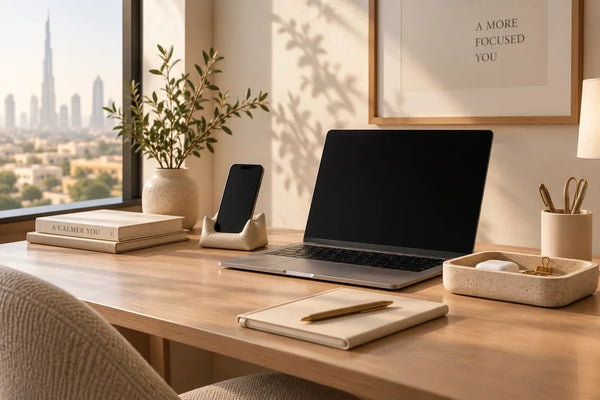
A considered desk supports concentration. And a considered home office can make working from home feel much more natural.
This is the difference between decorating a home and designing it around real life.
The Simple Test
Ask yourself:
Does this space make everyday life easier, calmer, or more enjoyable?
If it does, you are already moving towards a more intentional home.
Start With How You Actually Live
Before changing your home interior, observe it.
For a few days, notice where things naturally end up.
-
Where do your keys go when you walk through the door?
-
Where does your phone rest?
-
Where does your book end up after reading?
-
Which chair do you actually sit in?
-
Where does clutter repeatedly collect?
These patterns tell you a great deal about your home.
They reveal where your space is already working and where it may need a little help.
This matters particularly in apartments and compact urban homes, where the same surface may need to serve several purposes.
Instead of asking:
"How should this room look?"
ask:
"What needs to happen here?"
That small shift can make home design much more practical.
If your workspace is one of the areas that never quite feels settled, our guide to work-from-home setup ideas explores how to create a workspace that feels like part of your home rather than a separate office.
Edit Before You Add
One of the simplest ways to create a more intentional home is to remove something.
The goal is not to make your home empty. It is to make the space easier to see and use.
Choose one surface: a bedside table, desk, console, coffee table, or kitchen counter.
Clear it completely.
Then ask of each item:
-
Do I use this regularly?
-
Do I genuinely enjoy having it here?
-
Does it belong in this room?
-
Does it make the space easier or harder to use?
-
Would the surface feel better with fewer things on it?
You may discover that the room does not need new décor.
It needs some breathing room.
This is one of the simplest principles of intentional home design:
Edit first. Then decide what is missing.
Give Everyday Objects a Proper Place
The objects we use every day are often the ones that create the most visual mess.
Phones. Glasses. Books. Keys. Remotes. Chargers. Notebooks.
They move around because they are useful.
The answer is not necessarily to hide them.
Instead, give frequently used things a place where they naturally belong.
A tray can gather small objects.
A stand can give a device a defined resting place.
A bowl can collect keys.
A shelf can make books accessible without letting them take over every surface.
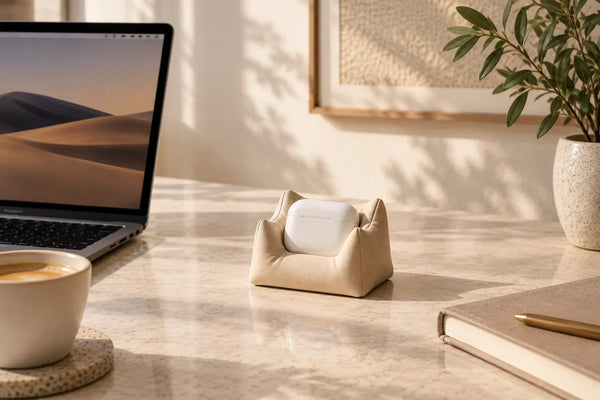
For example, if your phone tends to move between your desk, kitchen counter and bedside table, a dedicated phone stand can give it a consistent place while keeping it visible and accessible.
The specific solution depends on your home and routine. The principle is more important:
Useful things deserve useful places.
When everyday objects have somewhere to go, a room can feel calmer without becoming sterile.
Let Useful Objects Become Part of the Décor
There is often an unnecessary distinction between décor and utility.
Something is either decorative or practical.
Thoughtful interiors can be both.
A lamp provides light while contributing to the atmosphere.
A tray organises objects while becoming part of the composition.
A stand keeps something accessible while giving it visual structure.
Storage can reduce clutter without looking like an afterthought.
This is where functional home décor becomes valuable.
The best everyday objects do not need to demand attention.
They simply do their job well and happen to look at home while doing it.
This thinking also sits naturally alongside the principles of quiet luxury in home décor, where quality, restraint and thoughtful choices matter more than simply adding more.
For a modern home, that distinction matters. When an object is visible every day, usefulness and appearance should ideally work together.
Create Visual Calm Without Making Everything Match
A considered home does not need a perfectly coordinated colour scheme.
In fact, matching everything can make a room feel more arranged than lived in.
Instead, look for quiet relationships.
Perhaps several objects share warm neutral tones.
Maybe wood appears in more than one area.
A ceramic piece might echo another rounded form elsewhere.
A woven texture could soften an otherwise clean space.
The objects do not need to match.
They simply need to feel as though they can live together.
This approach works especially well with contemporary interiors such as Japandi style, where natural materials, restrained forms and thoughtful objects help create a calmer environment.
The goal is not to make every object identical.
It is to create enough visual connection that the room feels cohesive.
Design Around Everyday Moments
Good home design is not only about rooms.
It is about moments.
The first coffee of the morning.
Opening your laptop.
Reading before bed.
Coming home after a long day.
Getting ready for work.
Sitting down for a few quiet minutes.
These moments are where thoughtful home spaces become genuinely useful.
Consider a bedside table.
It is not simply a surface beside the bed. It supports a routine: perhaps a book, a glass of water, a phone, or a lamp.
A desk is not simply furniture. It is where work, concentration, and communication happen. If you're creating one from scratch, our desk setup ideas for Dubai homes explore practical ways to make a workspace functional without making it feel crowded.
Even a morning routine can benefit from a more considered environment. Our guide to creating a slow morning routine looks at how small changes to your surroundings can make the beginning of the day feel calmer.
When you design around these moments, even small changes can have a noticeable effect.
Make Smaller Spaces Work Harder
For many people living in Dubai and other GCC cities, the challenge is not simply the amount of space available.
It is making that space feel comfortable, functional, and personal.
An apartment can contain beautiful furniture and still feel crowded.
A large villa can contain plenty of space and still feel visually unsettled.
The answer is not always more storage or more décor.
Instead, consider how each area is being used.
Could one surface serve its purpose with fewer objects?
Could an everyday item have a more convenient home?
Could furniture allow clearer movement through the room?
Could a small corner become a useful reading, working, or resting space rather than remaining unused?
This is where thoughtful accessories can make a difference. A compact stand, for example, can give a phone or tablet a dedicated place without requiring another large piece of furniture.
Thoughtful home design is not measured by square footage.
It is measured by how well the space supports the people living in it.
Make Your Home Feel Personal
Intentional does not mean impersonal.
A home should still have evidence of a life being lived in it.
Keep the things that mean something.
A photograph.
A favourite book.
Something collected while travelling.
A gift.
A family object.
A piece of art that you simply enjoy looking at.
These things do not need to follow an interior trend.
They need to belong to you.
A home becomes warmer when the objects around you have a connection to the people who live there.
This is also why timeless interiors tend to age well. They are not built entirely around what is fashionable at one particular moment.
They leave room for life.
Choose Fewer, Better Things
There will be moments when your home genuinely needs something.
Perhaps an object would make a routine easier.
Perhaps something has no proper place.
Perhaps an existing item no longer works for the way you live.
That is when buying something new can make sense.
But begin with the need.
Ask:
What problem am I trying to solve?
Then:
What would solve it well?
And finally:
Does it belong in the space?
This simple sequence can make choosing home accessories much more intentional.
Instead of buying something because a surface looks empty, you are choosing an object because it contributes something.
That might be function.
It might be beauty.
Ideally, it is both.
The important thing is that it earns its place.
How to Choose Thoughtful Home Accessories
If you are considering a new piece for your home, look beyond whether it simply looks good in a photograph.
Consider five questions:
1. Does It Solve a Real Problem?
The best additions usually have a clear purpose.
2. Will You Actually Use It?
An attractive object that spends most of its life unused may not be the right choice.
3. Does It Work With the Space?
Consider scale, placement, surrounding objects, and how people move through the room.
4. Will It Remain Useful Beyond a Trend?
Timeless design tends to have a longer relationship with the home.
5. Does It Feel Like It Belongs?
The right object should feel naturally connected to the space rather than inserted into it.
This is a useful way to think about thoughtful home décor: not as filling empty spaces, but as choosing things that improve the experience of living in them.
A Five-Minute Reset for a More Thoughtful Home
If an everyday space feels slightly off, try this quick reset.
1. Clear the Surface
Remove everything temporarily.
Seeing the space without its usual clutter helps you reassess it.
2. Return Only What Belongs
Put back the things you genuinely use or want to see.
3. Give Everyday Objects a Home
Look at the things that repeatedly migrate around the room.
They may need a more intentional resting place.
4. Leave Some Negative Space
You do not need to fill every shelf, table, or corner.
Empty space allows the things you choose to keep to feel more considered.
5. Check the Routine
Use the space normally.
If something keeps getting moved, that is useful information.
The arrangement may need to change.
6. Keep Something Personal
Make sure the space still feels like yours.
A thoughtful home should never feel like a showroom.
Thoughtful Living Starts With Small Decisions
A more considered home does not appear overnight.
It develops through small choices.
Moving an object closer to where you actually use it.
Removing something that has become unnecessary.
Giving a favourite book a proper place.
Leaving a little more space on a surface.
Choosing one useful object instead of several decorative ones.
Keeping something because it has meaning rather than because it matches.
These decisions may seem small.
Together, they change the experience of living in a space.
Whether you are furnishing a new Dubai apartment, refreshing a family home in the UAE, or simply trying to make one corner of your home feel better, you do not need to start with a shopping list.
Start by paying attention.
Notice what your home is asking for.
Then make one thoughtful change.
At 3CHIC, this is the thinking behind Designed to Belong: everyday objects should earn their place through usefulness, beauty, and a sense of connection to the spaces and routines they become part of.
Because a beautiful home is not necessarily the one with the most beautiful things.
It is the one where the things that are there feel right.
Every object earns its place.
Frequently Asked Questions
What Makes a Home Feel More Considered?
A considered home combines function, beauty, and personal meaning. Everyday objects have a purpose, frequently used items have natural places, and the space supports the routines of the people living there.
How Can I Make My Home Feel More Thoughtful Without Buying Anything?
Start by removing unnecessary objects, clearing crowded surfaces, giving everyday items proper places, and rearranging existing pieces around the way you actually use the space.
How Do I Make a Dubai Apartment Feel More Intentional?
Focus on function as well as appearance. Reduce visual clutter, make everyday objects easy to access, use available surfaces carefully, and choose furniture and accessories that support your actual routines.
Does a Thoughtful Home Have to Be Minimalist?
No. A thoughtful home can contain books, artwork, photographs, decorative pieces, and personal belongings. The important question is whether the things in the space feel purposeful and connected to the people who live there.
How Do I Choose Home Accessories for an Intentional Home?
Start with a genuine need. Choose accessories that improve a routine, solve a practical problem, contribute to the room, or combine useful function with lasting visual appeal.
How Can I Make Everyday Objects Look Better in My Home?
Give them defined places, group related objects thoughtfully, create some surrounding negative space, and choose functional objects whose shape and appearance work naturally with the room.
What Is the Difference Between a Styled Home and a Considered Home?
A styled home primarily focuses on appearance. A considered home considers appearance alongside function, routines, personal meaning, and how the space is actually lived in.
Can Small Changes Really Make a Home Feel Better?
Yes. Clearing a crowded surface, moving an object closer to where it is used, or creating a proper place for frequently used items can improve both the appearance and function of a space.