care
Slow Mornings: A Ritual Worth Designing For
Create a slower, calmer start to the day with simple ideas for organising your phone, bedside table, desk and everyday essentials.

A slow morning isn't really about having more time. It's about how few decisions the first twenty minutes of the day ask of you.
When your phone, keys, charger and other everyday essentials all have a place, the morning begins with less searching and less friction. Your home starts doing some of the work for you.
That's where thoughtful home decor and everyday accessories can make a difference. A phone stand beside the bed, a small catch-all for keys, or a considered desk setup can turn a rushed morning routine into something closer to a ritual.
A slow morning doesn't require a complicated routine or an empty schedule.
Sometimes, it simply requires a home that is easier to move through.
What Is a Slow Morning?
A slow morning is a way of starting the day with less rushing, fewer unnecessary decisions and more attention on what you're actually doing.
It doesn't necessarily mean waking up hours earlier, spending an hour journaling or following an elaborate wellness routine.
For some people, a slow morning might mean drinking coffee before opening a laptop. For someone else, it might mean reading for ten minutes, making breakfast without checking notifications or simply having a bedroom that feels calm when they wake up.
The common thread is less friction.
When everyday objects have fixed places and your surroundings don't constantly demand your attention, the first part of the day can feel more deliberate.
Why Do Slow Mornings Feel So Rare?
Most mornings aren't slow by accident.
They're rushed because small decisions accumulate.
Where is my phone?
Where did I leave my keys?
Where's the charger?
Why is yesterday's cup still on the desk?
Where are my earbuds?
None of these questions takes very long to answer individually.
Together, they create friction before the day has properly started.
This is why organisation can have such a noticeable effect on a morning. A clutter-free desk, an organised bedside table and a few well-placed everyday accessories mean fewer things to search for and fewer objects to move around.
A slow morning isn't necessarily about doing less.
It's about removing the small obstacles that make everything feel rushed.
How Do You Create a Slow Morning Routine?
You don't need to completely redesign your mornings.
Start by looking at the first twenty minutes of a typical day and notice where friction appears.
If you always search for your phone, give it a dedicated place. If your keys end up in a different place every evening, create a simple catch-all. If your desk is covered with things before you start work, decide what actually needs to remain there.
Then build your routine around those small changes.
A simple slow morning might look like:
- Wake up without immediately searching for misplaced things.
- Open the curtains and let the room change with the morning light.
- Make coffee or breakfast without rushing through it.
- Spend a few minutes doing something you genuinely enjoy.
- Move into your workday or other responsibilities when you're ready.
There is no perfect slow morning routine.
The point is to create a beginning that feels intentional rather than reactive.
Start With Your Environment
It's easy to think of a morning routine as a list of personal habits.
But your surroundings matter too.
A bedroom full of loose chargers, clothes, devices and miscellaneous objects can make the morning feel busy before you've done anything.
The same is true of a kitchen counter or home office.
A calmer environment doesn't have to be minimalist in the strict sense. It simply needs to make sense.
Objects that you use regularly should be easy to find. Objects that don't need to be visible don't necessarily need to stay on the surface.
And the things that remain visible should ideally have a reason for being there.
This is where minimalist home accessories can be useful. The best ones aren't simply decorative. They solve small everyday problems while fitting naturally into the space around them.
How Can Your Home Support a Slower Morning?
A home can support a slower morning by reducing the number of small decisions you need to make.
Think about the objects you interact with immediately after waking:
Your phone.
Give it a dedicated place rather than allowing it to disappear beneath bedding or clutter.
Your keys and wallet.
Keep them together in one predictable location.
Your coffee or breakfast essentials.
Keep frequently used items accessible without overcrowding the counter.
Your workspace.
Leave the desk ready for the transition from morning routine to work.
The idea isn't to make everything perfectly organised.
It's to make the things you use every day predictable.
When you know where something is, you don't have to think about where it is.
That small difference is surprisingly valuable first thing in the morning.
Designing a Morning Around Minimalist Home Accessories
The appeal of minimalist home accessories isn't purely aesthetic.
Well-designed accessories can make a space easier to use.
A phone stand can keep your phone upright and visible instead of lying flat beneath papers. A small catch-all can give keys, a wallet or other everyday objects a fixed place. A bedside phone stand can keep your phone off the bed and make the transition from sleeping to getting ready feel more organised.
These are small changes.
That's precisely why they work.
A slow morning doesn't need a dramatic lifestyle overhaul. It can begin with a handful of objects doing their jobs properly.
The best modern desk accessories often disappear into the routine in this way. You use them every day without having to think about them.
Where Should You Put Your Phone in the Morning?
One of the simplest ways to reduce morning friction is to give your phone a dedicated place.
Beside the bed, a phone stand can keep the device upright and easy to find rather than buried beneath a pillow or tangled in a charging cable.
At the kitchen counter, it can keep a recipe, podcast or morning playlist visible without requiring you to hold the phone.
At your desk, it can keep the screen at a useful angle for calls or quick reference.
The important distinction is that having a place for your phone doesn't mean having to check it constantly.
A dedicated stand can actually make it easier to decide when you want to interact with your phone and when you don't.
Instead of reaching around for it every few minutes, you know exactly where it is.
Make Your Bedside Table Part of the Ritual
The bedside table is one of the smallest surfaces in a home, but it has an outsized effect on the beginning and end of the day.
When it's covered with chargers, jewellery, books, cups and loose objects, the surface can quickly become another source of visual noise.
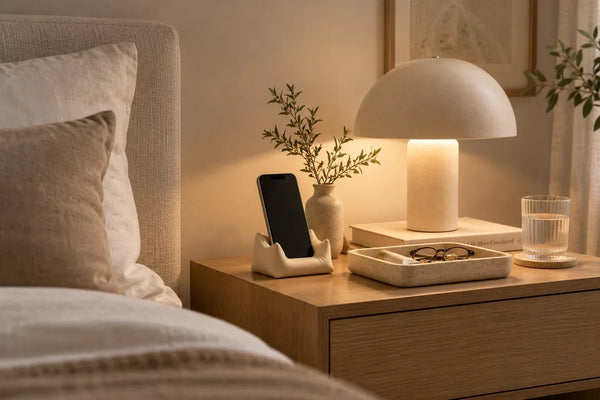
A calmer bedside table might contain only the things you actually use.
A soft lamp.
A book.
Your phone.
One small personal object.
That's enough.
A dedicated bedside phone stand, such as The Pillow, can keep your phone upright and contained rather than allowing it to become part of a pile.
For more ideas, see our guide to creating a calm, considered bedside table.
The goal isn't to create a perfectly styled nightstand.
It's to make the surface easy to reset each evening and easy to return to each morning.
Bringing the Slow Morning Into Your Workspace
For many people, the slow morning ends when work begins.
But the transition doesn't have to feel abrupt.
If you work from home, your desk may be part of the same room where you drink coffee, read or spend time with your family. That makes the relationship between your workspace and the rest of your home particularly important.
A cluttered desk can make the room feel busy even when everything else is calm.
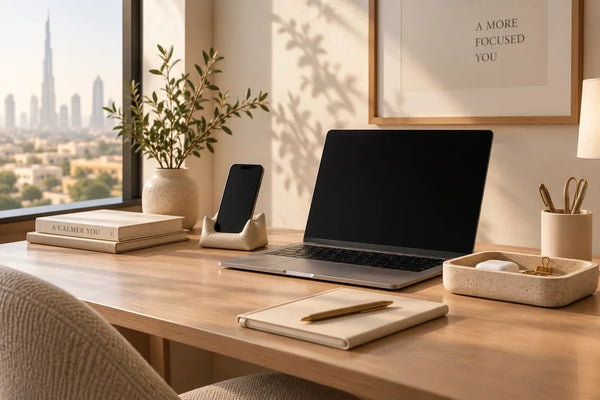
A few considered desk accessories can help create a cleaner transition.
A phone stand keeps your phone upright and accessible.
A tablet stand keeps a screen at a useful viewing angle.
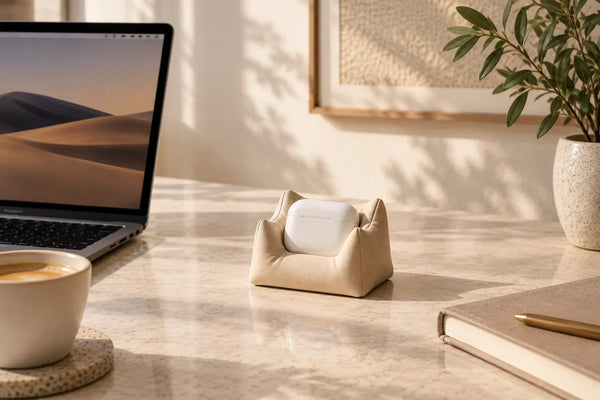
An earbud stand gives small wireless earbuds a fixed place rather than allowing them to disappear into a drawer or bag.
And the simplest accessory of all is open space.
Don't fill every available part of the desk simply because it's there.
A little room around the things you use can make the entire workspace feel easier to approach.
For more ideas, see our desk setup ideas for Dubai homes.
What Makes a Good Slow Morning Space?
A slow morning space doesn't need to look a certain way.
It can be colourful, neutral, traditional, contemporary or eclectic.
What matters more is whether the space supports the way you want to begin the day.
Look for:
Fewer Visual Distractions
You don't need to remove everything from the room. Simply reduce the number of things competing for your attention.
Easy-to-Find Essentials
Give everyday objects predictable homes so you don't have to search for them.
Comfortable Lighting
Natural morning light can change the feeling of a room, while a soft lamp can make early mornings feel less harsh.
Useful Objects
Choose accessories because they make something easier, not simply because they fill an empty surface.
Enough Empty Space
A clear section of a desk, bedside table or kitchen counter can be just as useful as the objects placed on it.
What Does Sustainable Home Decor Have to Do With Slow Mornings?
There is a natural connection between slow living and more considered consumption.
Both ideas encourage you to question whether you actually need another object, whether it serves a purpose and whether you're likely to keep using it.
That doesn't mean every product described as sustainable automatically is.
If you're choosing home accessories with sustainability in mind, look beyond the label and consider the material, manufacturing process, expected lifespan and whether the object genuinely earns a place in your home.
At 3CHIC, pieces are made from plant-based PLA and produced to order in the UAE rather than being mass-produced and stored until they are purchased.
The made-to-order approach means each piece is produced when it is needed, rather than simply being manufactured in large quantities and waiting on a shelf.
For a slow-home philosophy, that distinction matters.
The objective isn't to own more "sustainable" things.
It's to buy more intentionally and keep what works.
A Morning-Ready Setup
A slow morning doesn't require many objects.
A simple setup might include:
A phone stand at the bedside
Keep your phone visible and in one predictable place when you wake up.
A small catch-all
Give your keys, wallet or other everyday essentials a home rather than leaving them scattered across different surfaces.
A clear desk
Leave enough open space that moving into work doesn't immediately feel overwhelming.
A tablet or phone stand
Keep your device at a useful angle without propping it against books or other objects.
A place for your earbuds
Small wireless earbuds are easy to misplace. Giving them a fixed place means one less thing to search for.
You can explore the phone stands and tablet stands in the Settle Collection or read our guide to how to style a coffee table for another example of creating a more considered everyday space.
Frequently Asked Questions
What makes a morning routine feel slow without taking more time?
A slow morning routine reduces unnecessary decisions and small sources of friction. Giving everyday objects such as your phone, keys and earbuds a fixed place can make the beginning of the day feel calmer without requiring extra time.
How do I start having slower mornings?
Start with your environment rather than trying to change your entire routine. Give your most frequently used objects a fixed place, clear unnecessary clutter and decide what you want to do before reaching for your phone or starting work.
What should I keep on my bedside table?
Keep only the things you actually use. A soft lamp, book, phone stand and one or two personal objects can be enough. Leaving some open space makes the surface easier to use and reset.
Where should I put my phone when I wake up?
A dedicated phone stand beside the bed can keep your phone visible and easy to find without leaving it buried in bedding or mixed into other objects. You can then decide when you want to interact with it rather than searching for it first thing.
Can minimalist home accessories make a difference to a morning routine?
Yes. Small accessories can remove everyday friction by giving frequently used objects a predictable place. The benefit comes from making the home easier to use, not simply from having a minimalist aesthetic.
How can I create a slow morning when I work from home?
Create a small transition between waking up and beginning work. Give your phone and other essentials a fixed place, avoid starting the day immediately at your desk if possible, and keep your workspace organised enough that you can sit down and begin without first clearing it.
What makes a home feel calm in the morning?
A calm morning environment usually has fewer visual distractions, predictable places for everyday objects, comfortable lighting and enough open space to move through the routine without constantly rearranging things.
Is slow living the same as having a slow morning?
Not exactly. Slow living is a broader approach to everyday life, while a slow morning is simply a way of starting the day with more intention and less unnecessary rushing. A slow morning can be one small part of a slower lifestyle.
Designed for the First Twenty Minutes
A slow morning isn't a luxury reserved for people with empty schedules.
It's often the result of a few small decisions made in advance.
The phone has a place.
The keys have a place.
The desk doesn't need clearing before work can begin.
The bedside table isn't asking to be organised before you can even think about the day.
None of these things creates more time.
They simply remove some of the friction from the time you already have.
That's what makes a slow morning worth designing for.
Not more time. Just less to think about before the day begins.