behind 3chic
Home Office Accessories: What Is Actually Worth Having?
Which home office accessories are actually worth having? Discover practical ways to organise your desk, manage devices and create a workspace that feels calm and considered.

A home office does not need to be filled with accessories to work well.
In fact, the opposite is often true.
A desk can quickly become crowded with things that seemed useful when you bought them but rarely get used: cable organisers, decorative objects, extra stationery, gadgets and accessories that promise to make working easier but end up taking up more space.
The better approach is to ask a simpler question:
What is actually worth having on your desk?
The answer depends on how you work.
A designer may need different tools from someone who spends most of the day in video calls. A small apartment desk needs different solutions from a dedicated home office. And someone working from a dining table needs accessories that can be cleared away easily.
At 3CHIC, we think about home office accessories in much the same way.
An object should have a reason to exist.
It should make something easier, keep something organised, improve how you use your space—or simply make an everyday routine feel a little better.
The best home office accessories do not add clutter. They earn their place.
Key Takeaways
- The best home office accessories solve a real problem.
- Start with your work habits before buying desk accessories.
- A phone stand can improve visibility, access and desk organisation.
- A tablet stand can free up desk space while keeping a second screen accessible.
- Cable management matters because loose cables quickly create visual and practical clutter.
- Desk organisation should make frequently used items easier to reach, not simply hide everything.
- Small desks benefit from compact, multifunctional accessories.
- A visually calm workspace can make a home office feel more integrated into the rest of your home.
- You do not need every trending desk accessory to create an effective workspace.
- 3CHIC designs made-to-order accessories around everyday use, with products 3D-printed in the UAE.
In This Article
- What Home Office Accessories Are Actually Worth Having?
- How Do You Choose Home Office Accessories?
- What Should You Keep on Your Desk?
- Is a Phone Stand Worth Having on a Desk?
- Do You Need a Tablet Stand for a Home Office?
- What Desk Accessories Help With Organisation?
- How Do You Manage Cables on a Home Office Desk?
- Which Home Office Accessories Are Worth Skipping?
- How Do You Choose Accessories for a Small Desk?
- How Do You Make a Home Office Feel Calm?
- How 3CHIC Thinks About Home Office Accessories
- A Simple Home Office Accessories Checklist
- Frequently Asked Questions
What Home Office Accessories Are Actually Worth Having?
The home office accessories worth having are the ones you use consistently.
For most people, that means starting with a small group of practical essentials:
- A phone stand
- A laptop or monitor setup that suits your work
- A tablet stand if you regularly use a tablet
- A comfortable keyboard and mouse
- A desk lamp where needed
- A simple way to manage charging cables
- A small organiser or tray for everyday objects
- Something to keep important notes or documents accessible
You may need all of these.
You may need only a few.
The important thing is to build around your actual work rather than buying a predefined collection of desk accessories.
If you spend most of your day on a laptop, for example, adding five decorative desk accessories will not necessarily improve your workspace.
A stand that changes how you use your laptop might.
A phone stand that keeps your phone visible might.
A simple tray that stops small objects spreading across your desk might.
Function should be the starting point.
How Do You Choose Home Office Accessories?
Before buying a desk accessory, ask five questions.
1. What Problem Does It Solve?
If you cannot identify a clear problem, you may not need it.
2. Will You Use It Every Day?
Daily-use objects are usually the best candidates for a permanent place on your desk.
3. Does It Save Space or Create More?
An accessory should ideally make your desk more efficient rather than consuming valuable surface area without adding enough value.
4. Does It Work With Your Routine?
A product that looks good but interrupts your workflow is not particularly useful.
5. Does It Belong Visually?
Your home office is still part of your home.
The accessories you choose should work with the surrounding space rather than making your desk feel like a separate environment.
This is particularly important if you work from a bedroom, living room or dining area.
Our guide to work-from-home setup ideas explores this idea in more detail.
What Should You Keep on Your Desk?
A useful desk is not necessarily a completely empty desk.
You simply want the things you use most often to be easy to reach.
For many people, that means:
Laptop + phone + notebook + water + one or two useful accessories.
Everything else can have a different home.
Try dividing your desk into three zones:
Work Zone
Your laptop, monitor, keyboard and mouse.
Communication Zone
Your phone, tablet or other devices you regularly check.
Personal Zone
A notebook, small object, photograph or something else that makes the space feel like yours.
This creates a sense of order without requiring the desk to look sterile.
If you want more ideas for arranging a workspace in a UAE home, our guide to desk setup ideas for Dubai homes looks at practical ways to make a workspace feel calm and personal.
Is a Phone Stand Worth Having on a Desk?
For many people, yes.
Your phone is likely already part of your workday.
You may use it for calls, messages, two-factor authentication, calendars, music, timers or notifications.
Leaving it flat on the desk means it is easy to lose beneath notebooks, cables or other objects.
A phone stand gives it a defined position.
It can also make the screen easier to see and keep the device accessible without having to pick it up repeatedly.
The bigger benefit, however, is organisation.
Instead of your phone being another loose object on the desk, it becomes part of the desk setup.
That is exactly the kind of everyday problem we think about at 3CHIC.
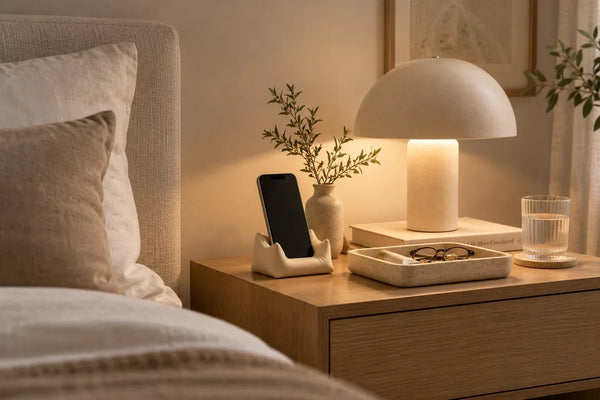
Our phone stands are designed to give the phone a considered place while keeping the overall workspace visually simple.
The aim is not to add another gadget.
It is to give something you already use a better place to live.
Do You Need a Tablet Stand for a Home Office?
If you regularly use a tablet alongside your computer, a tablet stand can be surprisingly useful.
A tablet might serve as:
- A second screen
- A reference display
- A video-call screen
- A reading device
- A note-taking surface
- A media or music display
Keeping it flat on the desk can take up more space than necessary and make the screen harder to view comfortably.
A stand raises the device and gives it a fixed position.
This can also make a desk feel more organised because each device has a defined place.
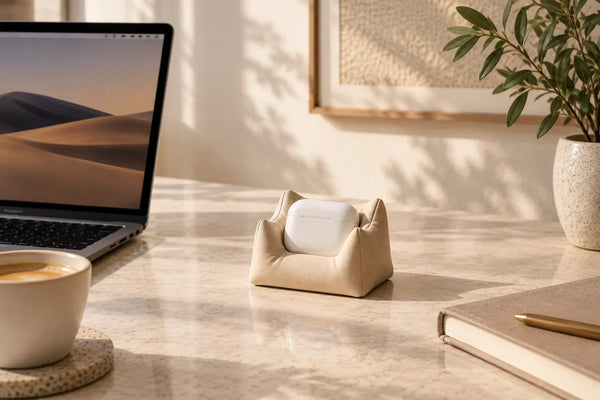
If you use a tablet regularly, explore the 3CHIC tablet stands to see how a dedicated stand can become part of a more considered workspace.
The same principle applies as with a phone:
If you use it every day, give it a proper place.
What Desk Accessories Help With Organisation?
The best desk organisers are the ones that reduce friction.
They help you find things faster, keep frequently used objects accessible and prevent small items from spreading across the surface.
Useful examples include:
- Trays
- Small organisers
- Device stands
- Cable-management solutions
- Document holders
- Pen holders
- Charging stations
But organisation does not mean putting everything into a container.
Sometimes the better solution is simply to remove what you do not need.
A desk covered with ten organisers can still be cluttered.
The goal is not more organisation.
It is less unnecessary movement and visual noise.
This is also why a phone or tablet stand can be more useful than another storage box. Instead of hiding the device away, you are giving it a predictable position.
How Do You Manage Cables on a Home Office Desk?
Cables are one of the easiest ways for a desk to start looking messy.
Laptop chargers, phone cables, monitor cables, headphones and other devices can quickly create a tangle.
Start by identifying which cables you actually use every day.
Then think about their route.
Ideally, cables should move towards the back or side of the desk rather than across the main working area.
Keep charging points close to where devices are placed.
And avoid keeping unnecessary cables plugged in simply because there is an available socket.
A good desk setup should make charging feel almost invisible.
This is another reason defined positions for devices can help. Once your phone or tablet has a permanent place, the corresponding cable has a natural destination too.
Which Home Office Accessories Are Worth Skipping?
Sometimes the best desk accessory is the one you do not buy.
Be cautious with accessories that:
- Solve a problem you do not actually have
- Take up more space than they save
- Duplicate something you already own
- Are difficult to use consistently
- Exist primarily because they are trending
- Make your workspace harder to clear
A home office does not need to look like a technology showroom.
You also do not need every accessory recommended by a productivity video.
Start with the things that genuinely improve your working day.
Then add slowly.
A useful rule is:
If removing an accessory makes no difference to your routine, you probably did not need it.
How Do You Choose Accessories for a Small Desk?
Small desks require more editing than large ones.
You have less room, so every object has a greater visual and practical impact.
Start with the essentials.
Then look for accessories that use space intelligently.
A vertical phone stand, for example, can keep your phone visible without requiring a large footprint.
A tablet stand can raise a second screen while keeping more of the desk available for your main work.
A small tray can group several loose objects into one visual area.
Think Vertically
When your desk is small, do not think only about the surface.
Think upwards.
Raising devices can free up horizontal space while also improving visibility.
This is particularly useful for home offices in apartments where a desk may need to fit into a bedroom, living room or compact corner.
The objective is not to make the desk look fuller.
It is to make the available space work harder.
How Do You Make a Home Office Feel Calm?
A calm workspace does not have to be completely minimal.
It needs to feel organised enough that your attention can stay on the work.
Start by reducing visual competition.
Keep your main working area clear.
Choose a restrained colour palette if that helps you feel settled.
Use natural textures where appropriate.
And avoid allowing every object you own to live permanently on the desk.
This is where the relationship between your workspace and your wider home matters.
A home office should not necessarily look like a corporate office placed inside your house.
It can feel connected to the rest of the interior.
For more on creating that sense of visual calm, see our guide to neutral interiors.
You may also find inspiration in quiet luxury home décor, particularly the idea of choosing fewer, more considered objects.
How 3CHIC Thinks About Home Office Accessories
At 3CHIC, we are interested in the objects that quietly improve everyday routines.
A phone stand does not need to become the focal point of a desk.
A tablet stand does not need to look like office equipment.
A useful accessory can simply make something easier while fitting naturally into its surroundings.
That is the thinking behind our Designed to Belong approach.
We create everyday objects around the way people actually use their spaces.
Our accessories are 3D-printed in the UAE and made to order, allowing us to focus on considered forms and practical use rather than producing objects simply to fill a category.
For a home office, that means thinking about questions such as:
Where does your phone naturally go?
Where does your tablet sit?
What objects do you reach for every day?
What keeps getting in your way?
What could have a better place?
These questions are more useful than simply asking which desk accessories are trending.
If an object makes your working day easier and still feels at home on your desk, it has earned its place.
Explore the 3CHIC desk accessories designed around everyday workspaces.
A Simple Home Office Accessories Checklist
Before buying anything new for your desk, work through this checklist.
Essential
- Comfortable working setup
- Reliable lighting
- Phone within easy reach
- Charging solution
- Basic cable management
Useful Depending on Your Work
- Phone stand
- Tablet stand
- Monitor stand
- Headphone stand
- Document holder
- Desk organiser
Personal
- Notebook
- Book
- Small plant
- Photograph
- Personal object
You do not need to tick every box.
The point of the checklist is to identify what your desk actually needs.
Frequently Asked Questions
What Are the Most Useful Home Office Accessories?
The most useful accessories are those that solve everyday problems. Depending on your work, these may include a phone stand, tablet stand, cable-management solution, desk organiser, monitor stand or good task lighting.
Is a Phone Stand Worth It for a Home Office?
A phone stand can be worthwhile if you regularly use your phone while working. It keeps the phone visible and accessible while giving it a defined place on the desk.
Do I Need a Tablet Stand?
A tablet stand can be useful if you regularly use a tablet as a second screen, for reading, video calls, note-taking or reference material. It can also free up desk space by raising the device.
What Should I Keep on My Home Office Desk?
Keep the things you use regularly within easy reach. For many people, this means a computer, phone, notebook, water and a small number of practical accessories.
How Do I Keep My Home Office Desk Organised?
Remove items you do not use regularly, give frequently used objects defined places and manage cables so they do not cross the main working surface. Avoid adding organisers simply for the sake of organisation.
How Do I Make a Small Desk More Functional?
Prioritise essentials and choose compact accessories that use vertical space effectively. Phone and tablet stands can help keep devices accessible while freeing up horizontal desk space.
How Many Desk Accessories Do I Need?
There is no ideal number. Start with the accessories that solve genuine problems in your workflow and add only when you identify another need.
Should Home Office Accessories Match?
They do not need to match exactly. A consistent colour palette, material or design language can help the workspace feel cohesive without making every object identical.
How Do I Make My Home Office Look Less Cluttered?
Clear unnecessary objects, group smaller items, manage cables and leave some open space on the desk. The simplest solution is often to own fewer desk accessories rather than finding more ways to organise them.
What Makes a Good Home Office Accessory?
A good home office accessory solves a genuine problem, is easy to use, does not take up unnecessary space and fits naturally into the workspace.
What Makes 3CHIC Home Office Accessories Different?
3CHIC focuses on everyday objects designed around practical use and considered form. Products are 3D-printed in the UAE and made to order, with the aim of creating useful pieces that feel natural within modern homes and workspaces.
A Better Desk Starts With What You Actually Need
A good home office does not need every accessory available.
It needs the right ones.
A phone stand because your phone is part of your workday.
A tablet stand because your tablet has become part of your workflow.
A tray because small objects keep spreading across your desk.
A cable solution because charging should not create a tangle.
A personal object because your workspace should still feel like yours.
These are small decisions, but they change how a desk works.
At 3CHIC, that is what we mean by Designed to Belong.
The goal is not to add more things to your workspace.
It is to create better places for the things you already use.
Every object earns its place.