behind 3chic
How to Style a Coffee Table: Simple Ideas for a Considered Space
Learn how to style a coffee table with simple ideas for arranging books, décor and everyday objects to create a balanced, considered living space.

A coffee table is one of those pieces of furniture that quietly shapes how a living room feels.
It holds the things you use, the things you enjoy looking at, and sometimes the things that have simply ended up there.
Styling it well is therefore not about creating a perfect arrangement that nobody is allowed to touch. It is about finding a balance between beauty, function and everyday life.
A few books, a tray, a sculptural object, a little greenery or something with personal meaning can be enough. The important part is knowing what deserves to be there—and what does not.
At 3CHIC, we think about everyday objects in much the same way. Our pieces are designed to be useful while still feeling at home in the spaces around them. Rather than hiding functional objects away, the idea is to let them become part of the room.
Whether your home is minimalist, warm and neutral, Japandi-inspired or quietly luxurious, the principle is simple:
A well-styled coffee table should feel considered without feeling untouchable.
Key Takeaways
- Start with how you actually use your coffee table before adding decorative objects.
- A good coffee table arrangement balances decorative and functional pieces.
- Use different heights, shapes and textures to create visual interest.
- Trays can group smaller objects and make an arrangement feel intentional.
- Books add height, texture and personality.
- Leave some of the table visible so the arrangement does not feel crowded.
- Small, round and rectangular coffee tables each benefit from slightly different styling approaches.
- Neutral interiors can feel layered through texture, shape and natural materials rather than lots of colour.
- At 3CHIC, we believe everyday objects should earn their place through both usefulness and design.
In This Article
- What Should You Put on a Coffee Table?
- How Do You Style a Coffee Table?
- How Many Items Should You Put on a Coffee Table?
- How Do You Style a Coffee Table Without Making It Look Cluttered?
- How Do You Use a Tray to Style a Coffee Table?
- Add Books for Height and Personality
- Mix Heights, Shapes and Textures
- How Do You Style a Small Coffee Table?
- How Do You Style a Round Coffee Table?
- How Do You Style a Coffee Table for a Neutral Interior?
- How Do You Mix Decorative and Functional Objects?
- How Does 3CHIC Approach Everyday Objects?
- How to Keep a Styled Coffee Table Practical
- A Simple Coffee Table Styling Formula
- Frequently Asked Questions
What Should You Put on a Coffee Table?
There is no single list of objects that every coffee table needs.
The best pieces are usually a combination of things that are useful, personal and visually interesting.
Depending on the size of your table and how you use your living room, you might include:
- A stack of books or magazines
- A decorative tray
- A small vase
- A candle
- A bowl
- A sculptural object
- A plant or simple greenery
- Coasters
- A remote-control holder
- One or two objects that have personal meaning
You do not need all of them.
In fact, using fewer objects often makes the arrangement feel more intentional.
Think about the coffee table as part of the room rather than an isolated styling project. The objects you choose should relate naturally to the furniture, colours and materials already around them.
For a warm neutral living room, for example, you might combine wood, cream ceramics, books and greenery.
For a more minimal space, you may need little more than a stack of books and one carefully chosen object.
If your wider home follows a calm, restrained aesthetic, our guide to neutral interiors explores how colour, texture and everyday objects can work together to create a calmer home.
How Do You Style a Coffee Table?
The easiest way to style a coffee table is to think in layers rather than individual objects.
Start with one larger or grounding element.
This might be a tray, a stack of books or a larger decorative object.
Then add one or two smaller pieces around it.
Finally, step back and look at the arrangement as a whole.
You are looking for balance rather than perfect symmetry.
For example:
Books + small object + greenery
or
Tray + candle + bowl
or
Books + sculptural object + small vase
These simple combinations create enough variation without making the surface feel busy.
Start With the Empty Table
Before styling, clear everything from the coffee table.
This gives you an opportunity to see its shape and scale.
Then consider how much of the surface you actually want to cover.
A coffee table should still be usable.
If you regularly put down a cup of coffee, open a laptop, read a book or play a board game there, leave enough space for those activities.
The styling should work around your life—not prevent it.
This idea of designing around real routines is central to the way we think about objects at 3CHIC. A useful piece should make everyday life easier while fitting naturally into the space.
How Many Items Should You Put on a Coffee Table?
There is no fixed number, but three to five intentional elements is a useful starting point for many coffee tables.
The exact number depends on the size and shape of the table.
A small table might need only two or three objects.
A larger rectangular table may comfortably hold several small groupings.
The important thing is not the number of objects but the relationship between them.
Too many similarly sized objects can make a table look cluttered.
Too few can sometimes make a large table feel unfinished.
Start with less.
You can always add another piece if the arrangement feels empty.
It is much easier to create a considered space by adding gradually than by trying to remove visual clutter afterwards.
How Do You Style a Coffee Table Without Making It Look Cluttered?
The secret is to create visual breathing room.
Not every part of the table needs to be occupied.
Leave areas of the surface visible.
You can also group objects together rather than spreading lots of small items across the entire table.
This is one reason trays work so well.
Instead of having a candle, bowl and small object sitting independently, they become one visual composition.
Use Negative Space
Negative space is simply the area you deliberately leave empty.
On a coffee table, it allows the objects you have chosen to stand out.
This is particularly useful in smaller living rooms, where too many decorative objects can quickly make the entire space feel crowded.
A considered arrangement should have somewhere for the eye to rest.
And importantly, the empty space is also what keeps the table functional.
How Do You Use a Tray to Style a Coffee Table?
A tray can be one of the simplest ways to bring order to a coffee table.
It gives smaller objects a defined area and makes the arrangement easier to move when you need the table for something else.
You might place a candle, small bowl and decorative object together on a tray.
Or use it to gather everyday items that would otherwise move around the room.
The important thing is not to treat the tray as another surface that needs filling.
Leave some room around the objects inside it.
Why Trays Work
A tray creates a visual boundary.
It tells the eye that several individual objects belong together.
That makes even a simple collection of everyday pieces feel more deliberate.
For a home where function and aesthetics need to coexist, this can be particularly useful.
At 3CHIC, this is part of the thinking behind our approach to everyday objects: function does not need to disappear simply because something is visible.
A practical object can still contribute to the aesthetic of a room.
Add Books for Height and Personality
Books are one of the most useful coffee table styling elements because they bring several things to an arrangement at once.
They add:
- Height
- Colour
- Texture
- Personality
- Something to browse
A small stack can create a visual base for another object.
For example, a sculptural piece placed on top of two books can immediately create more height and variation.
You can also choose books that reflect your interests rather than selecting them purely for their appearance.
A coffee table is part of a lived-in home.
The books on it can tell people something about you.
They do not need to be there simply because they look good.
Mix Heights, Shapes and Textures
If everything on your coffee table is the same height, shape or material, the arrangement can feel flat.
Try introducing contrast.
Pair a low stack of books with a taller vase.
Place a rounded bowl beside a more angular object.
Combine smooth ceramics with the texture of paper, wood or woven materials.
The aim is not to make the table visually complicated.
It is to create enough variation that the arrangement feels natural.
Think in Three Dimensions
Look at your coffee table from different angles.
An arrangement that looks balanced from the sofa might look crowded from the side.
Try placing objects at different heights and keeping taller pieces towards the back or centre where appropriate.
This helps create depth without filling every available space.
How Do You Style a Small Coffee Table?
Small coffee tables benefit from restraint.
When the surface is limited, every object becomes more noticeable.
Start with one functional or grounding piece.
A small tray, a short stack of books or a single sculptural object can be enough.
Then add one smaller element if needed.
Avoid using lots of tiny decorative pieces.
They can make a small table feel visually fragmented rather than thoughtfully styled.
Think Vertically
When horizontal space is limited, use height carefully.
A small vase or compact sculptural object can create interest without requiring much surface area.
But remember to keep sightlines comfortable, especially if the coffee table sits between a sofa and television.
A beautiful arrangement should not become something you have to look around.
This is the same principle we apply when designing compact 3CHIC accessories: small does not have to mean visually insignificant.
How Do You Style a Round Coffee Table?
Round coffee tables naturally encourage a softer, more organic arrangement.
Rather than creating a rigid linear composition, try grouping objects loosely around a central point.
For example, you could place:
A tray + books + small decorative object
slightly off-centre.
Or create two small groupings that balance each other without becoming symmetrical.
Rounded objects can work particularly well here because they echo the shape of the table.
You can also introduce contrast with a rectangular book or tray.
The goal is to create balance without making the table feel overly arranged.
How Do You Style a Coffee Table for a Neutral Interior?
Neutral coffee table styling works best when you focus on texture and tonal variation rather than adding lots of colour.
Cream, beige, warm white, taupe, soft grey, natural wood and muted earthy tones can all work together.
But if everything is exactly the same tone and texture, the arrangement can become flat.
Instead, combine materials.
Try:
- A warm wooden object
- A textured book
- A matte ceramic piece
- A simple tray
- A small amount of greenery
This creates depth while keeping the overall palette restrained.
If you enjoy this quieter approach to interiors, our guide to Japandi style explores the relationship between natural materials, restraint and thoughtful objects.
You can also explore our article on quiet luxury in home décor for another perspective on creating a home that feels refined without relying on excess.
How Do You Mix Decorative and Functional Objects?
A coffee table does not have to choose between looking beautiful and being useful.
In fact, the most successful arrangements usually combine both.
A tray can be decorative while holding everyday objects.
A bowl can be beautiful while collecting small items.
A book can add visual interest while being something you actually read.
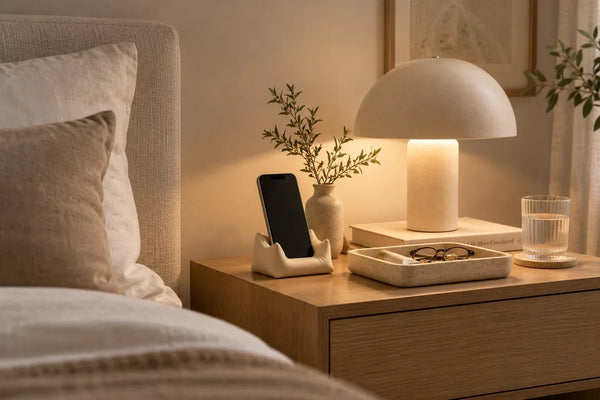
A stand can keep a device accessible while becoming part of the room.
This is where functional home décor becomes valuable.
An object does not need to be hidden simply because it has a practical purpose.
It can belong visibly in the room.
This philosophy extends beyond the coffee table. We explore the same idea in our article on how to make everyday spaces feel more considered: the things you use every day can also contribute to the atmosphere of your home.
How Does 3CHIC Approach Everyday Objects?
At 3CHIC, we are interested in the objects that sit quietly within everyday routines.
Not objects that exist simply to fill a shelf.
Not decorative pieces that become clutter.
But things that have a reason to be there.
That thinking is reflected in Designed to Belong—our approach to creating pieces that combine practical function with considered form.
Our products are 3D-printed in the UAE and made to order, allowing us to think carefully about the objects themselves, how they are used and how they fit into modern spaces.
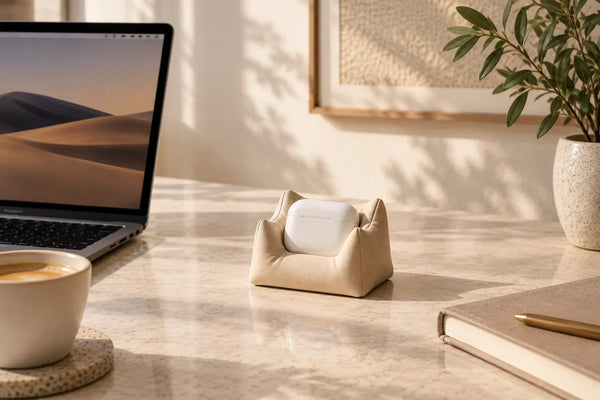
That might be a phone stand on a desk, a tablet stand beside a sofa, or another small object that solves an everyday problem without demanding attention.
The same principle can be applied to a coffee table.
Instead of asking:
"What can I put here?"
ask:
"What belongs here?"
That distinction is small, but it can completely change how you style a room.
If you are looking for other ways to bring this thinking into your home, explore the 3CHIC home collection.
How to Keep a Styled Coffee Table Practical
A coffee table is still a piece of furniture.
It needs to work.
If you have to move ten objects every time you want to put down a cup of coffee, the styling is probably too complicated.
Keep the things you use frequently easy to access.
Consider where books, coasters, remotes and other everyday objects naturally end up.
If something repeatedly gets moved off the table, that tells you something.
Perhaps it needs a different location.
Perhaps the arrangement needs fewer objects.
Or perhaps it needs a dedicated place within the composition.
This is where considered home design becomes more useful than styling for appearance alone.
The best arrangement is one that still works when you are actually living in the room.
A Simple Coffee Table Styling Formula
If you are not sure where to start, try this simple formula.
1. Choose One Anchor
Start with a tray, stack of books or larger object.
2. Add Something With Height
A vase, candle or sculptural object can create vertical interest.
3. Add Something Smaller
A bowl, small object or decorative piece can complete the grouping.
4. Introduce Texture
Look for contrast between materials such as paper, wood, ceramic, glass or woven textures.
5. Leave Space
Do not fill the entire surface.
6. Add One Useful Object
If there is something you use regularly, find a way to let it belong naturally within the arrangement.
7. Remove One Thing
When you think the arrangement is finished, try taking one object away.
Sometimes that final edit is what makes the table feel more considered.
Frequently Asked Questions
What Is the Best Way to Style a Coffee Table?
Start with one or two larger grounding elements, then add smaller objects with different heights, shapes and textures. Leave some of the surface visible so the arrangement remains practical.
What Should I Put in the Centre of a Coffee Table?
A tray, stack of books, vase, bowl or sculptural object can work well as a central element. The best choice depends on the size and shape of the table and how you use it.
How Many Items Should Be on a Coffee Table?
Three to five elements is a useful starting point for many tables, but there is no fixed rule. Smaller tables usually need fewer objects, while larger tables can accommodate several grouped arrangements.
Should a Coffee Table Have a Tray?
A tray is useful but not essential. It can group smaller objects together, create visual structure and make it easier to clear the table when needed.
How Do You Style a Coffee Table Without Making It Look Cluttered?
Use fewer objects, group related pieces together and leave some negative space. Varying the height and scale of objects can also make the arrangement feel more intentional.
How Do You Style a Small Coffee Table?
Choose a small number of useful or meaningful pieces and avoid filling the entire surface. One tray, a small stack of books or a single decorative object may be enough.
How Do You Style a Round Coffee Table?
Use a relaxed grouping rather than a rigid linear arrangement. Combine different shapes and heights while allowing the circular shape of the table to guide the composition.
What Looks Good on a Neutral Coffee Table?
Natural wood, ceramics, books, muted textiles, greenery and objects in warm neutral tones can create a layered look without introducing too much colour.
Should Coffee Table Décor Match the Rest of the Room?
It does not need to match exactly. Instead, look for relationships in colour, material, shape or texture so the coffee table feels connected to the wider room.
How Do You Keep a Styled Coffee Table Functional?
Leave enough clear space for everyday use and make frequently used objects easy to reach. If you constantly have to move decorative pieces out of the way, simplify the arrangement.
What Is the 3CHIC Approach to Home Accessories?
3CHIC focuses on everyday objects that combine practical function with considered design. The idea is that useful objects can remain visible and become part of the spaces they belong in, rather than being treated as clutter.
A Coffee Table That Looks Lived In
The most beautiful coffee tables are not necessarily the ones covered in carefully arranged objects.
They are the ones that feel like they belong in the room.
A book you actually read.
A tray that gathers the things you use.
A small object you brought home because you love it.
A vase that catches the light.
A practical piece that happens to look beautiful sitting there.
This is also the thinking behind 3CHIC.
We believe the objects that become part of everyday life should be useful enough to keep and considered enough to belong.
So when you're styling your coffee table, don't start by asking what is missing.
Start by asking what deserves a place.
Every object earns its place.