design
UAE Home Office Inspiration: 12 Aesthetic Desk Ideas
Get inspired by 12 UAE home office ideas for creating an aesthetic, practical and organised desk setup that works beautifully within your home.

Working from home in the UAE often means making a workspace work within the home you already have.
That might be a dedicated room, a compact apartment corner, a bedroom desk or even a small section of a living space. The challenge is not simply creating a desk that looks good. It is creating a workspace that feels comfortable, organised and connected to the rest of your home.
A good home office should support the way you actually work.
In a UAE home, that can mean thinking carefully about natural light, room temperature, available space, device placement, storage and the visual feel of the room. The goal is not to fill your desk with accessories. It is to create a space where everything has a reason to be there.
At 3CHIC, we think about desk accessories in much the same way. Everyday objects should solve a real problem while fitting naturally into the space around them.
Key Takeaways
- A good UAE home office should reflect how you actually work and the space available to you.
- An aesthetic desk does not need to be crowded with decorative accessories.
- Natural light, comfortable positioning and sensible cable management can make a noticeable difference.
- Small desks benefit from vertical organisation and compact accessories.
- Phone and tablet stands can free up valuable desk space while keeping devices visible and accessible.
- A restrained colour palette can help a workspace feel calmer and more connected to the rest of the home.
- The best desk accessories are useful first and decorative second.
- 3CHIC designs practical desk accessories in the UAE, including phone stands, tablet stands and coordinated desk pieces, made to order.
In This Article
- What Makes a Good Home Office in the UAE?
- 12 UAE Home Office Ideas for a More Aesthetic Desk
- How Do You Create an Aesthetic Desk Setup?
- How Do You Set Up a Home Office in a Small Dubai Apartment?
- What Should You Keep on a Home Office Desk?
- How Do You Keep a Desk Looking Minimal and Organised?
- How Can Desk Accessories Improve a Home Office?
- How 3CHIC Approaches the UAE Home Office
- A Simple UAE Home Office Checklist
- Frequently Asked Questions
What Makes a Good Home Office in the UAE?
A good home office should make working easier without feeling disconnected from the rest of your home.
For many people in the UAE, the available workspace has to serve several purposes. A desk may sit in a bedroom, living room or multipurpose room rather than in a dedicated office.
That makes flexibility important.
A practical home office should give you:
- Enough room for your everyday work
- Comfortable access to your computer and devices
- Good lighting without excessive glare
- A sensible place for chargers and cables
- Storage for things you use regularly
- Enough visual calm to help you concentrate
- Accessories that support your routine rather than create more clutter
The best UAE home office ideas are therefore not necessarily the most elaborate ones. They are the ones that make the available space work harder.
12 UAE Home Office Ideas for a More Aesthetic Desk
1. Position Your Desk Around the Natural Light
Natural light can make a home office feel brighter and more comfortable.
If possible, position your desk so you can benefit from daylight without placing your screen directly in front of a bright window. Side lighting can often work better than having the window directly behind or in front of your monitor.
For UAE homes, where bright sunlight can be particularly strong, consider how the light changes throughout the day rather than judging the position only in the morning.
A simple blind or curtain can help control glare while still allowing natural light into the room.
2. Keep the Desk Visually Simple
An aesthetic desk does not need to be a minimalist desk with absolutely nothing on it.
Instead, think about visual hierarchy.
Keep the objects you use most often within reach and move everything else into drawers, shelves or another storage area.
A useful rule is:
If an object does not help you work, organise something or make the space meaningfully better, it probably does not need to live on the desk.
This creates a cleaner background without making the workspace feel sterile.
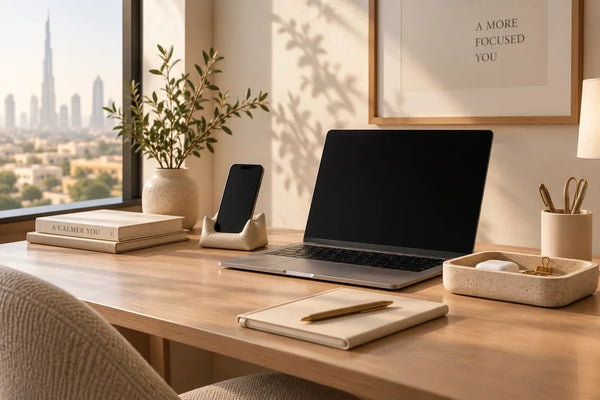
3. Create a Dedicated Place for Your Phone
Phones are useful at work, but they can also become one of the biggest sources of visual and physical clutter on a desk.
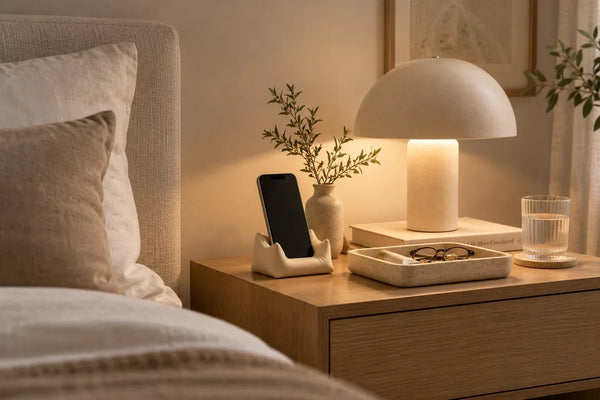
A phone stand gives the device a defined position.
Instead of lying flat beside your keyboard or disappearing underneath papers, your phone has a place where you can see it when you need it and move it out of the way when you do not.
This can be particularly useful for video calls, timers, notifications, music controls or simply keeping your phone visible without constantly picking it up.
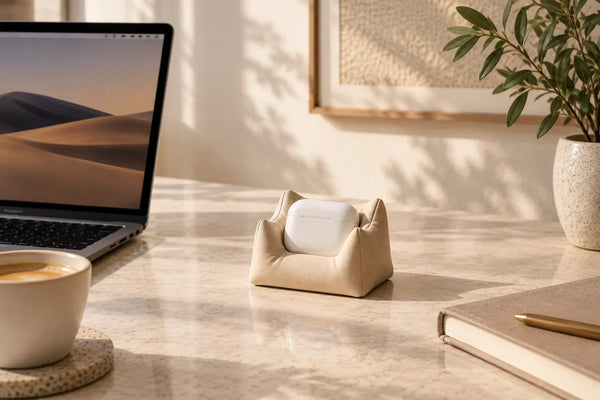
A well-designed phone stand can also become part of the visual language of the desk rather than looking like another piece of technology.
For example, 3CHIC's phone stands collection is designed around this idea: giving an everyday device a considered place without taking over the desk.
4. Use a Tablet Stand to Free Up Desk Space
If you regularly use a tablet for reference material, video calls, reading or a second screen, leaving it flat on the desk can quickly consume useful workspace.
A tablet stand allows you to raise the device and keep it in a defined position.
It can also make the desk feel more organised because your tablet becomes part of the workspace rather than another object competing for surface area.
This is especially useful on smaller desks, where using vertical space can make a meaningful difference.
Explore 3CHIC's tablet stands collection if your home office needs a more considered way to position everyday devices.
5. Make Cable Management Part of the Design
Cables are often what make an otherwise attractive desk look messy.
You do not need an elaborate cable-management system to improve the situation.
Start by identifying the cables you actually use every day.
Then:
- Keep charging cables close to their usual devices.
- Route cables towards the nearest power source.
- Avoid allowing excess cable to sit across the front of the desk.
- Group cables that travel in the same direction.
- Remove chargers and cables that are rarely used.
The goal is not to hide every cable at all costs.
It is to make cables predictable and unobtrusive.
6. Choose a Desk That Fits the Room
A desk should feel proportional to the space around it.
In a smaller Dubai apartment, an oversized desk can make the entire room feel cramped. In a larger dedicated office, an undersized desk may leave you without enough room for your everyday work.
Before choosing a desk, consider:
- How much surface area you genuinely need
- Where the chair will sit
- How drawers and doors will open
- Where power outlets are located
- How much walking space will remain
- Whether the desk needs to serve another purpose
The right desk is not necessarily the largest one you can fit.
It is the one that gives you enough working space while allowing the room to breathe.
7. Use Vertical Space on a Small Desk
When horizontal space is limited, look upwards.
Shelves, wall-mounted storage and raised device stands can help you make better use of a compact home office.
Even something as simple as raising a tablet or phone off the desk can create more usable surface area.
This is one reason compact desk accessories can be more valuable than large organisational systems. A small object that solves a specific problem without occupying much space can make a surprisingly large difference.
8. Choose a Restrained Colour Palette
Your desk does not need to match every piece of furniture in the room.
But it should feel like it belongs there.
Neutral colours, natural materials and a restrained selection of tones can make a workspace feel more connected to the surrounding home.
That does not mean your office needs to be completely beige or white.
A restrained palette can include warm wood, soft neutrals, black accents, muted colours or a small number of contrasting details.
The important thing is to create visual consistency rather than making every object compete for attention.
9. Let Useful Objects Become Part of the Décor
Some of the best home office accessories are objects you need anyway.
A desk lamp provides light.
A phone stand positions your phone.
A tablet stand supports a device.
A tray keeps small items together.
A document holder keeps papers accessible.
When these objects have thoughtful proportions and materials, they can contribute to the appearance of the desk rather than looking like purely functional additions.
This is an important part of creating an aesthetic workspace: you do not necessarily need more décor. You can make the useful things look and feel considered.
10. Create a Small Personal Area
A workspace should still feel like part of your home.
A photograph, small artwork, plant, book or meaningful object can make a desk feel more personal.
The key is restraint.
Choose one or two things that genuinely matter to you rather than filling the workspace with decorative objects simply because there is empty space.
A personal detail can make a home office feel more inviting without compromising its functionality.
11. Design the Desk for Video Calls
Video calls change how a home office needs to function.
Think about what appears behind you, where your camera sits and how much visual clutter is visible from the other side of the call.
A simple background can work better than an overly decorated one.
You may also want your phone or tablet positioned nearby for notes, reference material or a second communication device.
This is another situation where a stand can be useful: it gives the device a predictable position rather than leaving it balanced against books or lying flat on the desk.
12. Make the Workspace Feel Like Part of Your Home
The most successful home offices do not always look like offices.
If your desk sits in a bedroom or living area, choose pieces that work with the furniture and materials already there.
This might mean:
- Repeating a colour already used in the room
- Choosing accessories with simple forms
- Using natural textures
- Avoiding unnecessary visual clutter
- Selecting fewer, better objects
The result should feel intentional rather than like a temporary workstation that happens to have remained in the room.
How Do You Create an Aesthetic Desk Setup?
Start with function.
Before buying accessories or decorating the desk, ask what you actually do there.
Do you spend most of the day on a laptop? Do you use a monitor? Do you regularly take video calls? Do you use your phone as part of your work? Do you need a tablet nearby? Do you write by hand?
Once you understand your routine, the aesthetic decisions become easier.
A simple approach is:
Function → organisation → visual balance → personal details.
This prevents you from buying accessories first and then trying to find reasons to use them.
If you are building a workspace from scratch, our article on what a work-from-home setup should feel like explores the broader relationship between comfort, organisation and the home around your desk.
How Do You Set Up a Home Office in a Small Dubai Apartment?
Start by treating space as a resource.
You do not need a large room to create a useful home office. You need to make each part of the available space work well.
Choose the smallest desk that comfortably supports your work. Use vertical space where possible. Keep accessories compact. Give frequently used objects a fixed place.
Device stands can also help because they allow you to use vertical space instead of relying entirely on the desk surface.
If the workspace shares a room with another function, visual consistency becomes even more important.
A desk that looks like it belongs in the room will feel less intrusive when you are not working.
What Should You Keep on a Home Office Desk?
The answer depends on your work, but most home offices benefit from keeping only the things used regularly within immediate reach.
A useful starting point is:
Essential
- Computer or laptop
- Keyboard and mouse if needed
- Desk lamp if lighting requires it
- Phone
- Regularly used stationery
Useful depending on your work
- Phone stand
- Tablet stand
- Headphones
- Notebook
- Document holder
- Small tray
- Charging accessories
Better stored elsewhere
- Extra stationery
- Old paperwork
- Unused cables
- Packaging
- Decorative objects that have no meaningful purpose
The goal is not an empty desk.
It is a desk where the objects around you make sense.
How Do You Keep a Desk Looking Minimal and Organised?
Start by reducing rather than adding.
If a desk feels cluttered, buying another organiser is not always the answer.
First remove objects you do not use.
Then give the remaining objects a defined place.
This is particularly effective for small everyday items such as phones, tablets, chargers, headphones and stationery. When each has a predictable location, the desk becomes easier to reset at the end of the day.
This idea is closely connected to the principles we explore in neutral interiors and quiet luxury home decor: restraint does not mean having nothing. It means choosing deliberately.
How Can Desk Accessories Improve a Home Office?
A good desk accessory should solve a specific problem.
For example:
A phone stand can keep your phone visible and accessible.
A tablet stand can raise your tablet and free up surface space.
A tray can give small objects a defined home.
Cable management can prevent chargers from becoming tangled across the workspace.
A desk organiser can keep frequently used items together.
The common thread is simple: the accessory should make something easier.
At 3CHIC, this is the principle behind our approach to everyday objects. We are less interested in creating accessories simply because there is room for another product category, and more interested in asking what an object can genuinely improve.
How 3CHIC Approaches the UAE Home Office
A home office should not have to look like a generic office.
That idea sits at the heart of 3CHIC's approach to desk accessories.
Our phone stands, tablet stands and desk accessories are designed around everyday routines: where your phone goes when you are working, where your tablet sits during a call, how small objects are organised and how a desk can stay visually calm without becoming impractical.
The pieces are 3D-printed in the UAE and made to order, allowing the focus to stay on considered design rather than unnecessary excess.
You can explore the wider 3CHIC desk accessories collection if you are building or refining a home workspace.
The aim is not to make your desk look like a showroom.
It is to make the space you already have work better.
A Simple UAE Home Office Checklist
Before adding another accessory to your desk, ask:
Does it solve a real problem?
If yes, keep considering it.
Will I use it regularly?
If not, it may be better stored elsewhere.
Does it fit the available space?
A useful object that makes the desk difficult to use is not a useful addition.
Does it work with the rest of the room?
Your home office should feel connected to your home.
Does it make the workspace easier to reset?
The best systems are the ones you can maintain without thinking about them.
Frequently Asked Questions
What are the best home office accessories for a UAE home?
The best accessories depend on how you work, but useful options include a phone stand, tablet stand, desk lamp, cable-management solution, small tray and practical desk organiser. Prioritise accessories that solve a real problem rather than simply filling the desk.
How can I make my home office look aesthetic?
Start with the layout and remove unnecessary clutter. Then introduce a restrained colour palette, thoughtful lighting, a few personal details and useful accessories with simple forms. An aesthetic home office should still be comfortable and functional.
How do I make a small home office look bigger?
Use a desk that is proportional to the room, keep the surface relatively clear and make use of vertical space. Raising devices with compact phone or tablet stands can also help free valuable desk space.
What should I put on an aesthetic desk?
Start with the objects you actually use. A computer, lighting, phone, notebook and a few practical accessories may be enough. Add personal or decorative pieces selectively rather than filling every empty area.
Is a phone stand useful for a home office?
Yes, particularly if you regularly check your phone for calls, notifications, timers, music or work-related tasks. A stand gives the phone a defined position and can prevent it from taking up unnecessary desk space.
Do I need a tablet stand for my home office?
If you regularly use a tablet for video calls, reading, reference material or as a secondary screen, a tablet stand can make the workspace more comfortable and organised. It is especially useful on smaller desks.
How can I hide cables on my desk?
Start by reducing unnecessary cables, then route the remaining ones towards the nearest power source and group cables that travel together. Keeping charging points predictable can make cable management much easier.
How many accessories should I have on my desk?
There is no ideal number. A better rule is to keep the accessories that you use regularly and remove anything that adds clutter without improving your work or routine.
Should home office accessories match?
They do not need to match exactly. They should, however, feel visually compatible. Repeating similar colours, materials or forms can create a more cohesive workspace.
What makes 3CHIC desk accessories different?
3CHIC focuses on everyday objects that have a clear purpose while fitting naturally into the home. The accessories are 3D-printed in the UAE and made to order, with an emphasis on practical function, considered form and everyday use.
A Home Office That Works With Your Home
A good home office does not need to look like a traditional office.
It needs to support the way you work while fitting naturally into the space around it.
Start with the desk. Consider the light. Reduce unnecessary clutter. Give your everyday devices a proper place. Then add only the accessories that genuinely make the space easier to use.
The result can be simple, practical and personal.
And that is often what makes a home office feel most considered: not how much you put into it, but how deliberately you choose what stays.