guides
How to Style a Bedside Table Without Making It Feel Cluttered
Simple ideas for styling a bedside table without clutter, from choosing what belongs to creating visual balance, negative space and a calmer everyday setup.

Your bedside table doesn't need to be filled with beautiful objects to feel finished.
In fact, some of the most effective bedside table styling comes from doing less: keeping the things you genuinely use, giving them a place, and leaving enough space for the surface to breathe.
The bedside table is a particularly important part of the bedroom because it sits so close to your everyday routines. It's where your phone rests at night, where your book waits for you, where you reach for your glasses in the morning and where a small lamp can make the room feel softer at the end of the day.
When all of those things accumulate without a system, even a beautiful bedroom can suddenly feel cluttered.
The solution isn't necessarily to buy new bedside table decor.
It's to make better decisions about what belongs.
Key Takeaways
- Start with your actual routine rather than a decorative checklist.
- Choose one visual anchor, usually the lamp, and build around it.
- Use differences in height to create visual balance without adding more objects.
- Keep colours and materials visually connected.
- Give small everyday objects a defined place instead of letting them spread across the surface.
- Leave some empty space so the bedside table remains practical as well as beautiful.
- A dedicated phone stand can keep your phone accessible without allowing it to dominate the surface.
- Small bedside tables benefit most from fewer, more purposeful objects.
- Personal objects should add meaning rather than simply fill space.
In This Article
- What Makes a Bedside Table Feel Cluttered?
- How Do You Style a Bedside Table Without Clutter?
- How Do You Choose What Belongs on a Bedside Table?
- How Do You Create Visual Balance on a Bedside Table?
- Where Should Your Phone Go at Night?
- How Do You Style a Small Bedside Table?
- How Do You Keep Small Objects Organised?
- Should Bedside Tables Match?
- What Should You Remove From Your Bedside Table?
- How Do You Reset a Cluttered Bedside Table?
- Frequently Asked Questions
What Makes a Bedside Table Feel Cluttered?
A bedside table usually feels cluttered when too many objects compete for attention or when everyday things don't have a defined place.
Common culprits include:
- loose charging cables
- several small objects scattered across the surface
- too many decorative pieces
- books that have accumulated rather than been intentionally placed
- products you rarely use
- water glasses left behind
- jewellery and small personal items
- objects that belong somewhere else
The number of objects isn't the only issue.
Five carefully arranged things can feel calmer than three things placed randomly.
Good bedside table styling is therefore less about counting objects and more about creating visual hierarchy, purpose and breathing room.
This is the same principle that works across a considered home: everyday objects don't need to disappear. They simply need a thoughtful place within the space.
You can explore this idea further in our guide to making everyday spaces feel more considered.
How Do You Style a Bedside Table Without Clutter?
The easiest approach is to start with an empty surface.
Clear everything away, then return only what you actually use or genuinely value.
From there, build the arrangement in layers:
- Choose your main visual anchor.
- Add one or two essential everyday objects.
- Group small items together.
- Create contrast in height.
- Check the colour and material relationships.
- Leave some visible empty space.
This creates a bedside table that feels styled without looking staged.
The objective isn't to create a perfectly symmetrical arrangement. It's to make the surface feel intentional and easy to live with.
How Do You Choose What Belongs on a Bedside Table?
Start with your evening and morning routine.
What do you reach for every night?
Perhaps it's:
- your phone
- a book
- glasses
- water
- hand cream
- earbuds
- a lamp
- one small personal object
Those are your starting points.
You don't need to recreate someone else's bedside table from Pinterest or Instagram.
If you don't read before bed, you don't need a decorative stack of books.
If you don't use a candle, it doesn't need to live beside your lamp simply because it looks good there.
The best bedside table ideas begin with how you actually live.
This is also why styling works best when it supports the wider character of the bedroom. If your room follows a restrained, neutral palette, for example, you can use the principles in our guide to creating calm neutral interiors rather than adding objects that introduce unnecessary visual noise.
How Do You Create Visual Balance on a Bedside Table?
Once you've decided what belongs, choose one object to act as the visual anchor.
For most bedside tables, this will naturally be the lamp.
It is usually the tallest object and therefore gives the arrangement a clear starting point.
Other possibilities include:
- a sculptural object
- a vase
- a framed photograph
- a stack of books
- another object with noticeable visual weight
Place the anchor first.
Then arrange the smaller objects around it.
Create Different Heights
If every object sits at exactly the same height, the arrangement can feel flat.
Try creating three levels:
Tall: lamp
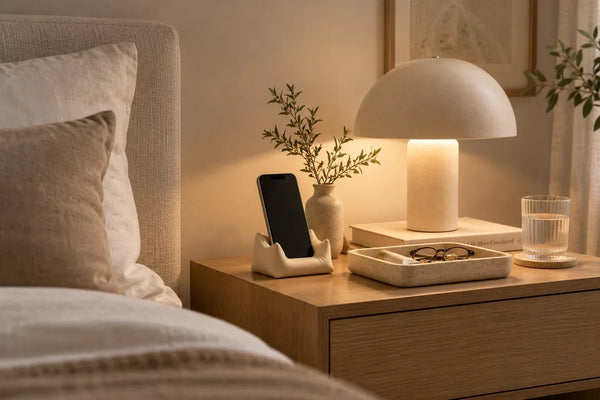
Medium: vase, phone stand or personal object
Low: book, tray, glasses or jewellery
You don't need to measure anything.
Simply look for contrast.
A taller object next to something low creates visual movement without requiring additional decoration.
This is particularly useful for a minimalist bedside table, where you may only have three or four objects to work with.
Keep the Colour Palette Connected
Your bedside table doesn't need to be colour-matched.
But if every object introduces a completely different colour, finish or material, the small surface can start to feel visually noisy.
Instead, look at the colours already present in your bedroom.
Perhaps you have:
- warm wood
- cream or ivory
- muted green
- soft blue
- black accents
- natural linen
Choose bedside objects that relate to what is already around them.
The goal isn't perfect matching.
It's visual connection.
Repeating one material or tone can make separate objects feel as though they belong together.
How Do You Keep Small Objects Organised?
Small things are often responsible for most of the mess.
Jewellery.
Earbuds.
Hair ties.
Lip balm.
Keys.
Charging accessories.
Glasses.
Instead of allowing these objects to spread across the surface, give them a defined zone.
A small tray can be enough.
The tray doesn't have to be decorative. Its value is that it creates a boundary.
Rather than having five small objects scattered across the table, you have one organised area.
This is where bedside table accessories should earn their place: by solving a real problem.
Organisation doesn't have to mean hiding everything away. It can simply mean making the objects you use regularly easier to see, reach and return.
Where Should Your Phone Go at Night?
For many people, the phone is the most difficult object to integrate into a calm bedroom.
You need it.
But it can also look visually disruptive.
Rather than pretending it doesn't belong, give it a defined position.
An aesthetic phone stand can keep your phone upright and accessible while making it feel more intentional within the overall arrangement.
This is particularly useful when your bedside table is small.
Instead of the phone lying flat and taking up horizontal surface area, it has a dedicated vertical position.
A well-designed phone stand can also feel more at home beside a lamp, book and personal objects than a conventional holder that looks unmistakably like office technology.
The idea isn't to hide the phone.
It's to give it a place.
If you're interested in the wider role of phone stands within considered spaces, our phone stand collection explores the same balance between everyday function and visual simplicity.
How Do You Style a Small Bedside Table?
When the surface is small, every object needs to earn its place.
Start with the essentials.
A simple arrangement might be:
lamp + phone + book + one personal object
If you need water, include it.
If you don't read, remove the book.
If your phone takes up too much space, consider a vertical phone stand.
The smaller the table, the more important it becomes to think about surface area.
Decorative objects should be chosen carefully because they compete directly with the things you actually need.
This is why the best small bedside table ideas are often surprisingly simple.
Think Vertically
A small surface doesn't necessarily mean you have to remove everything you enjoy.
Look for objects that use vertical rather than horizontal space.
A lamp already does this. A phone stand can do it too.
The result is more usable surface area without sacrificing the things that form part of your routine.
How Do You Add Personality Without Adding Clutter?
A bedside table should still feel like yours.
The solution isn't to remove all personality in the pursuit of minimalism.
Choose one or two objects that have meaning.
It might be:
- a favourite book
- a photograph
- a small handmade object
- something collected while travelling
- a piece of ceramics
- a meaningful gift
One personal object can say more about the person living in the room than a collection of generic decorations.
This is also where a restrained approach can work particularly well. If you enjoy the calm, natural quality of Japandi style, for example, personality doesn't need to come from adding more things. It can come from choosing one object with genuine meaning.
Should Bedside Tables Match?
No.
Matching bedside tables can create beautiful symmetry, particularly in a more traditional or structured bedroom.
But they aren't essential.
Different bedside tables can work together when they share something visually:
- colour
- material
- proportion
- shape
- visual weight
The same principle applies to styling.
One side might have a book and glasses.
The other might have a phone stand and a small object.
The bedroom can still feel cohesive without making both sides identical.
The same idea applies to the accessories themselves: match the visual logic, not necessarily the objects.
What Should You Remove From Your Bedside Table?
If your bedside table feels cluttered, don't immediately look for a storage solution.
First ask whether everything needs to be there.
Remove:
- empty cups
- receipts
- packaging
- old notes
- unused products
- tangled cables
- objects from other rooms
- decorative items you no longer notice
- books you've finished
Then look again.
Ask:
Does this object support my routine, have personal meaning or contribute meaningfully to the space?
If the answer is no, it probably doesn't need to occupy prime bedside real estate.
This is one of the simplest principles behind a more considered home: edit before you add.
How Do You Reset a Cluttered Bedside Table?
You don't need to redesign your bedroom every time the bedside table gets messy.
Try this five-minute reset instead.
1. Clear the Surface
Remove everything.
Starting from an empty surface makes it easier to distinguish what belongs from what has simply accumulated.
2. Return What Doesn't Belong
Put objects back where they actually live.
3. Keep Your Essentials
Return only the things you regularly use.
4. Re-establish Your Visual Anchor
Usually, this means placing the lamp first.
5. Give Your Phone a Defined Position
Place it where it can remain accessible without disrupting the arrangement.
6. Leave Some Space
Don't fill the surface simply because there is room.
That final step is important.
Empty space isn't wasted space.
It gives the objects you've chosen room to breathe and gives you somewhere practical to put down your phone, book or glass of water.
A Calmer Bedside Table Doesn't Need More Things
It's tempting to think that a beautifully styled bedside table requires more beautiful objects.
Usually, it requires better editing.
Keep what supports your routine.
Give everyday things a place.
Choose objects that relate visually.
Allow some empty space.
And let the things you genuinely love have room to be noticed.
A bedside table is a very small part of a bedroom, but it sits directly inside some of your most repeated daily rituals. When the surface works well, the room can feel easier to live in.
The goal isn't to create a perfect bedside table.
It's to create one that feels easy to live with.
Frequently Asked Questions
How do I style a bedside table without clutter?
Start by removing everything and returning only the objects you genuinely use. Choose one visual anchor, group smaller items together, create different heights and leave some empty space.
How many items should be on a bedside table?
There is no fixed number. Three to five functional or meaningful objects can be a useful starting point, but the size of the table and your personal routine should determine what stays.
What should I keep on my bedside table?
Common essentials include a lamp, phone, book, glasses and water. You can also keep one or two personal objects that are meaningful to you.
How do I make my bedside table look minimalist?
Remove anything unnecessary, keep the colour palette restrained, group small objects together and leave visible empty space. Minimalism is more about intentional editing than simply having fewer possessions.
How do you decorate a small bedside table?
Prioritise essentials and choose objects that serve a purpose. Use vertical space where possible and avoid filling the surface with decorative objects that don't add value.
What makes a bedside table look cluttered?
Loose cables, too many small objects, unrelated colours, unnecessary decoration and objects that don't belong in the bedroom can all contribute to visual clutter.
Should bedside tables match?
No. They can match for symmetry, but different bedside tables can also work beautifully when their colours, materials or visual weight relate to each other.
Is an aesthetic phone stand useful on a bedside table?
Yes. An aesthetic phone stand can give your phone a defined place while keeping it accessible and reducing the amount of horizontal surface it occupies.
How do you make bedside table accessories look cohesive?
Choose objects that share a colour, material, finish or general visual weight. They don't need to match exactly; they simply need to feel as though they belong within the same room.